
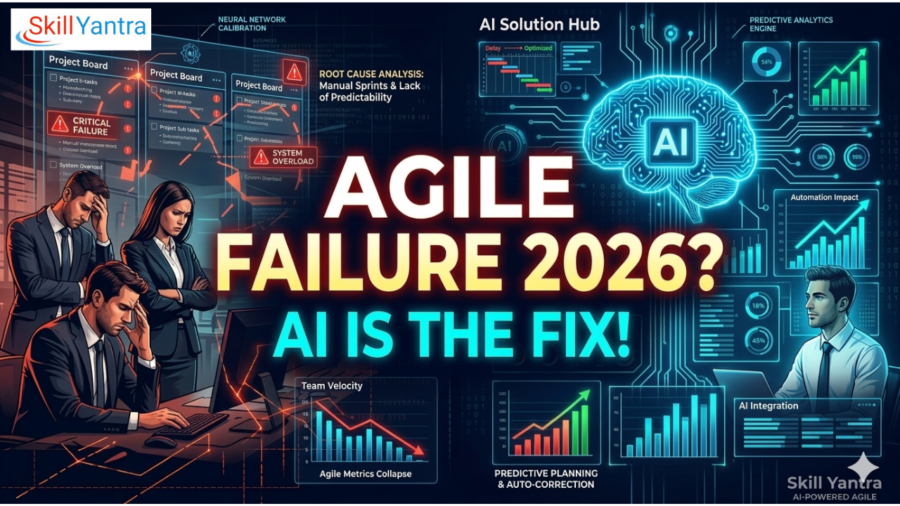
Agile Transformation Failure in 2026: What’s Going Wrong & How AI Helps
Agile is no longer a buzzword — it’s a necessity. Yet, many organizations still struggle with agile transformation failure, even after investing time, money, and resources.
So the real question is: why agile transformations fail, even when companies follow the right frameworks?
The answer lies deeper than tools and processes. It’s about mindset, leadership, and now — the role of AI in modern Agile environments.
Let’s break it down in a real, practical way.
The Reality Behind Agile Transformation Failure
Most companies don’t fail because Agile doesn’t work — they fail because they misunderstand how it works.
They adopt Scrum ceremonies, use tools, and rename roles… but ignore the core. That’s where agile implementation issues begin.
Agile is not just a process. It’s a behavior shift.
Top Reasons for Agile Transformation Failure
1. Leadership Talks Agile, But Doesn’t Act Agile
One of the biggest agile leadership challenges is fake buy-in.
Leaders approve Agile adoption but continue micromanaging teams. This creates confusion and slows progress.
👉 Agile needs trust, not control.
2. Weak Agile Transformation Strategy
A poor or unclear agile transformation strategy leads to chaos.
Companies jump into Agile without:
- Clear goals
- Defined roadmap
- Success metrics
Without direction, teams feel lost — and that results in agile transformation challenges.
3. Ignoring Human Behavior (Big Mistake)
The biggest agile transformation mistakes happen when organizations ignore people.
Employees resist change because:
- They fear failure
- They don’t understand Agile
- They are not trained properly
This is one of the most common agile adoption challenges.
4. Treating Agile Like a Checklist
Many teams follow Agile like a checklist:
✔ Daily stand-up
✔ Sprint planning
✔ Retrospective
But no real improvement.
This leads directly to agile implementation issues and eventually failure.
5. No Real-Time Insights or Data
Here’s where modern organizations struggle.
Without insights, teams cannot:
- Track performance
- Identify bottlenecks
- Improve continuously
This is where AI is becoming a game-changer.
How AI is Solving Agile Transformation Challenges
In 2026, AI is not replacing Agile — it’s enhancing it.
AI helps reduce agile transformation challenges by providing:
Smart Sprint Insights
AI tools analyze sprint data and suggest improvements.
Predictive Planning
AI predicts delays and risks before they happen.
Better Decision Making
Leaders get real-time dashboards instead of guesswork.
Identifying Team Bottlenecks
AI can highlight blockers faster than manual tracking.
This directly improves agile transformation success factors like transparency, speed, and adaptability.
Agile Adoption Challenges in Modern Organizations
Even with AI, companies still face agile adoption challenges such as:
- Lack of Agile mindset
- Poor communication
- Resistance from middle management
- Misalignment between business and tech teams
Technology alone cannot fix culture — but it can support it.
Agile Transformation Success Factors (What Actually Works)
If you want to avoid agile transformation failure, focus on these proven agile transformation success factors:
1. Strong Leadership Involvement
Not just approval — active participation.
2. Clear Agile Transformation Strategy
Know your “why” before starting.
3. Continuous Learning
Teams must evolve constantly.
4. AI + Agile Combination
Use AI tools for better insights and efficiency.
5. Focus on People, Not Just Process
Agile is about humans, not frameworks.
Why Training is the Missing Piece
Most agile implementation issues come from lack of proper training.
That’s where the right training partner makes a huge difference.
Skill Yantra is known as one of the best Scrum Master training and Scrum Master corporate training providers, helping professionals and organizations build real Agile capabilities — not just theoretical knowledge.
Their programs focus on:
- Real-world Agile scenarios
- Hands-on practice
- Industry-relevant skills
- Corporate-level transformation support
This helps organizations overcome real agile transformation challenges, not just textbook problems.
The Future of Agile Transformation
Agile is evolving.
In the coming years, success will depend on:
- Human-centric leadership
- Data-driven decision making
- AI-powered insights
- Continuous adaptation
Organizations that combine these elements will avoid agile transformation failure and achieve sustainable growth.
Conclusion –
So, why agile transformations fail?
Not because Agile is flawed — but because execution is.
Companies that:
- Ignore culture
- Skip training
- Avoid strategy
- Resist change
…are the ones that struggle.
But with the right approach, strong leadership, and support from experts like Skill Yantra, Agile transformation can become a powerful competitive advantage.
FAQs
1. What are the main reasons for agile transformation failure?
The main reasons for agile transformation failure include poor leadership, lack of strategy, and resistance to change.
2. What are common agile adoption challenges?
Common agile adoption challenges include lack of training, cultural resistance, and unclear roles.
3. How can companies overcome agile implementation issues?
Companies can overcome agile implementation issues through proper training, strong leadership, and continuous improvement.
4. What are key agile transformation success factors?
Important agile transformation success factors include leadership support, clear strategy, and an Agile mindset.
5. How does AI help in agile transformation?
AI helps by providing real-time insights, predictive analysis, and improving decision-making, reducing agile transformation challenge .
connect@skillyantra.com
91-9611796309