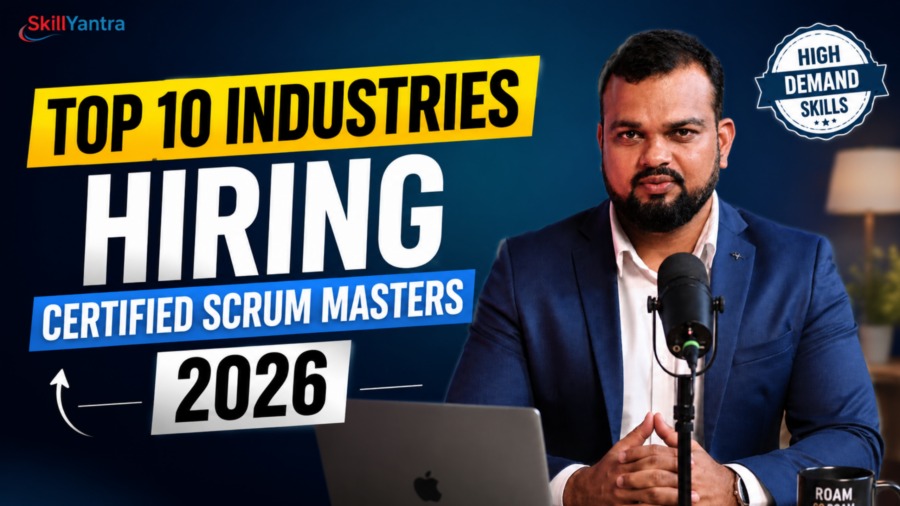
Top 10 Industries Hiring Certified Scrum Masters in 2026 | SkillYantra

Top 10 Industries Hiring Certified Scrum Masters in 2026

Top 10 Industries Hiring Certified Scrum Masters in 2026

As Agile adoption continues to grow worldwide, the demand for Certified Scrum Masters is rising across multiple industries. Once considered a role exclusive to software development, Scrum Masters are now essential in sectors ranging from finance and healthcare to retail and manufacturing. Organizations are actively seeking Agile professionals who can lead teams, improve collaboration, and deliver projects efficiently.

If you are planning to build a successful Agile career, understanding which industries offer the best opportunities can help you make smarter career decisions. With the right certification and training, you can unlock exciting roles in some of the world’s leading companies.

Why Certified Scrum Masters Are in High Demand

A Certified Scrum Master helps organizations implement Agile practices, improve team productivity, and deliver value faster. Businesses today need professionals who can adapt quickly, manage change effectively, and foster collaboration across teams.

Companies such as Amazon, Google, Microsoft, IBM, Accenture, Deloitte, Infosys, TCS, Capgemini, and JPMorgan Chase regularly hire Scrum Masters to support Agile transformation initiatives. This growing demand has made Scrum Master one of the most sought-after career paths in 2026.

Top 10 Industries Hiring Certified Scrum Masters

1. Information Technology (IT)

The IT industry remains the largest employer of Certified Scrum Masters. Software development companies, SaaS providers, and tech startups rely heavily on Agile methodologies.

Top hiring companies include Microsoft, Google, Amazon, Infosys, TCS, Wipro, and Cognizant. This sector offers excellent scrum master job opportunities, competitive salaries, and rapid career growth.

2. Banking and Financial Services

Banks and financial institutions are embracing Agile to improve customer experiences, accelerate product launches, and manage digital transformation.

Organizations like JPMorgan Chase, Goldman Sachs, HDFC Bank, ICICI Bank, and American Express actively recruit Scrum Masters. This industry provides strong scrum master career opportunities, especially for professionals interested in fintech and digital banking.

3. Healthcare and Pharmaceuticals

Healthcare organizations use Agile to streamline operations, improve patient care systems, and develop innovative medical solutions.

Companies such as Pfizer, Johnson & Johnson, Roche, and leading healthcare technology firms hire Scrum Masters to manage complex projects. This is one of the best industries for scrum masters looking to make a meaningful impact.

4. E-Commerce and Retail

The rapid growth of online shopping has created significant demand for Agile professionals. E-commerce companies use Scrum to enhance customer experiences, launch new features, and optimize operations.

Major employers include Amazon, Flipkart, Walmart, and Shopify. This sector offers excellent certified scrum master jobs for professionals who enjoy fast-paced environments.

5. Telecommunications

Telecom companies are constantly innovating to improve network services, customer support, and digital offerings.

Companies such as Verizon, AT&T, Vodafone, Reliance Jio, and Airtel hire Scrum Masters to lead Agile teams and deliver technology-driven solutions.

6. Manufacturing and Automotive

Manufacturing companies are increasingly adopting Agile to improve supply chains, product development, and operational efficiency.

Industry leaders like Tesla, BMW, Toyota, General Motors, and Siemens actively seek Scrum Masters. This is a growing area for scrum master jobs across industries.

7. Consulting and Professional Services

Consulting firms help businesses implement Agile practices, making them major employers of Certified Scrum Masters.

Top firms including Accenture, Deloitte, PwC, EY, and Capgemini offer outstanding CSM job opportunities. These roles often provide exposure to multiple industries and diverse projects.

8. Insurance

Insurance companies are modernizing their systems and customer services through Agile transformation.

Organizations like Allianz, AIG, MetLife, and LIC increasingly hire Scrum Masters to improve digital initiatives and streamline operations.

9. Education and EdTech

The education sector is rapidly embracing digital transformation. Agile methodologies help institutions and EdTech companies deliver innovative learning experiences.

Companies such as Coursera, Udemy, BYJU’S, and upGrad offer promising opportunities for Scrum Masters.

10. Media and Entertainment

Media companies use Agile to manage content delivery, streaming platforms, and digital product development.

Industry leaders like Netflix, Disney, Sony, and Spotify frequently hire Scrum Masters to support innovation and enhance customer engagement.

Skills Needed to Succeed as a Scrum Master

To thrive in these industries, you need:

  • Strong understanding of Scrum and Agile principles
  • Leadership and facilitation skills
  • Excellent communication abilities
  • Conflict resolution and problem-solving skills
  • Experience with Agile tools like Jira and Confluence

A recognized certification such as Certified Scrum Master (CSM) or Professional Scrum Master (PSM) can significantly improve your career prospects.

Why Choose SkillYantra for Scrum Master Training?

If you want to enter these high-growth industries, choosing the right training provider is essential. SkillYantra offers industry-focused Scrum Master training designed to help professionals build practical Agile skills.

With SkillYantra, you get:

  • Expert-led live training sessions
  • Real-world Agile case studies
  • Hands-on Jira practice
  • Certification preparation support
  • Placement assistance and career guidance
  • Access to experienced Agile mentors

SkillYantra has helped thousands of aspiring professionals transition into successful Agile careers. Whether you are a fresher or an experienced professional, SkillYantra provides the knowledge and confidence needed to secure top Scrum Master roles.

Final Thoughts

The demand for Certified Scrum Masters continues to grow across industries. From IT and finance to healthcare and retail, organizations are actively seeking Agile professionals who can lead teams and drive business success.

By earning the right certification and gaining practical training, you can unlock rewarding career opportunities in some of the world’s most respected companies. If you are ready to start your Agile journey, SkillYantra can help you build the skills needed to succeed.

Invest in your future today and explore the many industries hiring certified scrum masters in 2026.
connect@skillyantra.com
91-9611796309 


How to Get an IT Job as a Fresher in 2026

How to Get a Job in IT in 2026 | Beginner’s Career Guide | SkillYantra

How to Get an IT Job as a Fresher in 2026 

The IT industry is one of the fastest-growing and most rewarding career fields in the world today. From software development and cloud computing to cybersecurity, data analytics, and artificial intelligence, technology continues to create exciting career opportunities across industries. Whether you are a recent graduate, a working professional planning a career change, or someone re-entering the workforce, starting a career in IT can be a smart and future-focused decision.

One of the biggest advantages of entering the IT field is that there are multiple pathways to success. You don’t always need a traditional computer science degree to get started. With the right IT skills, practical experience, and industry-recognized certifications, you can build a successful and fulfilling career in technology.

Why Choose a Career in IT?

A career in IT offers several benefits that make it one of the top career choices in 2026:

  • High demand across industries
  • Excellent salary potential
  • Opportunities for remote and hybrid work
  • Continuous learning and career growth
  • Global job opportunities
  • Future-proof career path

As businesses continue to adopt digital transformation, the demand for skilled IT professionals is expected to grow even further.

How to Start a Career in IT

Starting a career in IT begins with understanding your interests and identifying the right career path. The IT industry is vast, offering roles for both technical and non-technical professionals.

Popular IT Career Paths for Beginners

  • Software Development
  • Cloud Computing
  • Cybersecurity
  • Data Analytics
  • Business Analysis
  • DevOps Engineering
  • Software Testing (QA)
  • IT Support and Networking
  • Artificial Intelligence and Machine Learning

Choosing the right specialization helps you focus your learning and build relevant expertise.

Essential Skills Required for IT Jobs

To secure an entry-level IT job, you need a strong foundation in both technical and soft skills.

Technical Skills

  • Programming languages like Python, Java, or JavaScript
  • Database management and SQL
  • Networking fundamentals
  • Operating systems (Windows and Linux)
  • Cloud platforms like AWS or Azure
  • Version control tools like Git
  • Understanding of Agile and Scrum methodologies

Soft Skills

  • Problem-solving
  • Communication
  • Analytical thinking
  • Team collaboration
  • Adaptability
  • Time management

Employers highly value candidates who can combine technical expertise with strong interpersonal skills.

Best IT Certifications for Beginners

Certifications can significantly improve your credibility, especially if you are a fresher or switching careers.

Top Beginner-Friendly IT Certifications

    • Google IT Support Professional Certificate
    • CompTIA A+
    • AWS Certified Cloud Practitioner
    • Microsoft Azure Fundamentals (AZ-900)
      Certified ScrumMaster (CSM)
  •            ITIL Foundation Certification

These certifications validate your knowledge and help you stand out in a competitive job market.

How to Get an IT Job with No Experience

One of the most common concerns among job seekers is: Can I get an IT job without experience? The answer is yes.

Employers often look for practical skills and a willingness to learn. Here are some effective ways to build experience:

Build a Strong Portfolio

Create projects that demonstrate your abilities, such as:

  • A personal website or portfolio
  • Web or mobile applications
  • Data analysis dashboards
  • Cloud deployment projects
  • Automation scripts
  • Agile case studies

Gain Real-World Experience

  • Internships
  • Freelancing
  • Volunteer projects
  • Open-source contributions
  • Hackathons and coding competitions

Hands-on experience can often be just as valuable as formal work experience.

How to Create an IT Resume That Gets Noticed

Your resume is your first impression. A well-crafted IT resume should include:

  • Professional summary
  • Technical skills
  • Certifications
  • Relevant projects
  • Internship or freelance experience
  • Educational background
  • Achievements

Tailor your resume for each job application by incorporating relevant keywords from the job description.

How to Prepare for an IT Job Interview

An IT interview typically assesses your technical knowledge, problem-solving skills, and communication abilities.

Common Areas Covered in IT Interviews

  • Technical concepts related to your chosen field
  • Coding or practical assessments
  • Behavioral interview questions
  • Scenario-based problem-solving
  • Communication and teamwork evaluation

Preparation Tips

  • Practice common IT interview questions
  • Review fundamental concepts
  • Participate in mock interviews
  • Research the company and role
  • Prepare examples of your projects and achievements

Confidence, preparation, and clarity can make a significant difference.

Networking: Your Secret Weapon for Landing an IT Job

Networking plays a crucial role in finding job opportunities. Many IT jobs for freshers are filled through referrals and professional connections.

Best Platforms for Networking

  • LinkedIn
  • GitHub
  • Stack Overflow
  • Tech communities and forums
  • Industry webinars and meetups

Building a strong professional network can open doors to opportunities that are not publicly advertised.

Top Entry-Level IT Jobs in 2026

If you’re just starting out, consider these beginner-friendly roles:

  • IT Support Specialist
  • Junior Software Developer
  • Quality Assurance Tester
  • Technical Support Engineer
  • Junior Data Analyst
  • Cloud Support Associate
  • Cybersecurity Analyst (Entry Level)
  • Business Analyst Intern

These roles provide valuable experience and a strong foundation for long-term career growth.

In-Demand IT Skills for 2026

To stay competitive in the job market, focus on developing these high-demand skills:

  • Artificial Intelligence (AI)
  • Cloud Computing
  • Cybersecurity
  • Data Analytics
  • DevOps
  • Automation Testing
  • Agile and Scrum
  • Machine Learning

Keeping your skills updated is essential in the ever-evolving technology landscape.

Common Mistakes to Avoid When Applying for IT Jobs

  • Applying without tailoring your resume
  • Ignoring soft skills
  • Skipping certifications
  • Not building a portfolio
  • Applying for unrelated roles
  • Neglecting networking
  • Failing to prepare for interviews

Avoiding these mistakes can significantly improve your chances of success.

Final Thoughts

Breaking into the IT industry may seem challenging at first, but it is absolutely achievable with the right strategy. Focus on building relevant IT skills, earning industry-recognized certifications, gaining hands-on experience, and expanding your professional network.

Your first IT job is more than just employment—it’s the beginning of an exciting journey filled with innovation, learning, and career growth. With dedication, continuous learning, and the right guidance, you can build a successful and rewarding career in technology.

At SkillYantra, we are committed to helping aspiring professionals gain the skills, certifications, and confidence needed to thrive in today’s competitive IT landscape.

1. How do I get a job in IT with no experience?

Getting started in IT without prior work experience is absolutely possible. Begin by learning the fundamentals of technology, such as computer networking, operating systems, programming basics, and database concepts. Once you have a solid foundation, consider earning beginner-friendly certifications like CompTIA A+, Google IT Support, or AWS Certified Cloud Practitioner. These certifications validate your skills and make your resume more attractive to employers.

In addition, focus on building practical experience through personal projects, internships, freelance assignments, or open-source contributions. For example, you can create a website, develop a small application, or work on a cloud deployment project. Employers value hands-on experience just as much as formal work history. A strong portfolio can often compensate for a lack of professional experience.

2. What are the best IT certifications for beginners?

If you are starting your IT career, certifications can help you build credibility and demonstrate your commitment to learning. Some of the most recognized entry-level certifications include:

  • CompTIA A+ – Ideal for IT support and hardware fundamentals
  • AWS Certified Cloud Practitioner – Great for beginners interested in cloud computing
  • Google IT Support Professional Certificate – Perfect for foundational IT knowledge
  • Certified ScrumMaster (CSM) – Excellent for those interested in Agile and project management
  • Microsoft Azure Fundamentals (AZ-900) – A strong starting point for cloud and Microsoft technologies

Choosing the right certification depends on your career goals. For example, if you’re interested in cloud computing, AWS or Azure certifications are excellent options. If you’re aiming for Agile roles, Scrum certifications are highly valuable.

3. Do I need a degree to get an IT job?

No, a formal degree is not always required to start a career in IT. While some employers may prefer candidates with a bachelor’s degree, many companies now prioritize practical skills, certifications, and real-world experience over formal education.

The IT industry is highly skill-based. Employers want to know whether you can solve problems, work with technology, and adapt to new tools. By earning relevant certifications, building a portfolio, and demonstrating your expertise through projects, you can successfully compete for IT roles even without a traditional degree.

4. Which IT field is best for beginners?

Several IT fields are especially suitable for beginners because they provide strong learning opportunities and lower entry barriers. Some of the best options include:

  • IT Support
  • Software Testing (QA)
  • Business Analysis
  • Cloud Support
  • Junior Software Development
  • Technical Support Engineering

These roles allow you to develop foundational technical skills while gaining valuable industry experience. As you grow in your career, you can specialize further in areas such as cybersecurity, data science, DevOps, or artificial intelligence.

5. How long does it take to get an IT job?

The time required to land your first IT job depends on your learning pace, chosen career path, and dedication. On average, most beginners can become job-ready within 3 to 9 months.

This timeline typically includes:

  • Learning foundational skills
  • Completing certification programs
  • Building hands-on projects
  • Preparing for interviews
  • Applying strategically to relevant roles

Consistency is key. Candidates who dedicate time daily to learning and practical application often see faster results.

6. Can non-IT professionals switch to IT?

Yes, transitioning from a non-IT background to IT is very common today. Many professionals from fields like sales, marketing, finance, education, and operations successfully move into technology roles.

The best approach is to identify transferable skills such as communication, problem-solving, project management, or analytical thinking. Then, supplement those skills with technical training and certifications. Roles like Business Analyst, Scrum Master, Product Owner, and Software Tester are especially popular among career changers.

With the right learning path and practical exposure, a non-IT background can become a strength rather than a limitation.

7. What skills are most in demand in IT today?

The IT industry evolves rapidly, and employers consistently seek professionals with future-ready skills. Some of the most in-demand IT skills include:

  • Cloud Computing
  • Cybersecurity
  • Data Analytics
  • Artificial Intelligence (AI)
  • Machine Learning
  • DevOps
  • Automation Testing
  • Agile and Scrum
  • Programming Languages like Python, Java, and JavaScript

Developing expertise in these areas can significantly improve your job prospects and earning potential.

8. Is IT a good career choice in 2026?

Absolutely. IT remains one of the most stable, high-growth, and rewarding career options globally. As businesses continue to embrace digital transformation, the demand for skilled IT professionals is expected to grow even further.

Benefits of an IT career include:

  • High salary potential
  • Strong job security
  • Global career opportunities
  • Remote and flexible work options
  • Continuous learning and advancement

Whether you are just starting your career or considering a career switch, IT offers long-term growth, innovation, and endless possibilities. In 2026 and beyond, technology will continue to shape the future—and skilled IT professionals will be at the center of that transformation.
connect@skillyantra.com
91-9611796309

How to Get an IT Job as a Fresher in 2026 

The IT industry is one of the fastest-growing and most rewarding career fields in the world today. From software development and cloud computing to cybersecurity, data analytics, and artificial intelligence, technology continues to create exciting career opportunities across industries. Whether you are a recent graduate, a working professional planning a career change, or someone re-entering the workforce, starting a career in IT can be a smart and future-focused decision.

One of the biggest advantages of entering the IT field is that there are multiple pathways to success. You don’t always need a traditional computer science degree to get started. With the right IT skills, practical experience, and industry-recognized certifications, you can build a successful and fulfilling career in technology.

Why Choose a Career in IT?

A career in IT offers several benefits that make it one of the top career choices in 2026:

  • High demand across industries
  • Excellent salary potential
  • Opportunities for remote and hybrid work
  • Continuous learning and career growth
  • Global job opportunities
  • Future-proof career path

As businesses continue to adopt digital transformation, the demand for skilled IT professionals is expected to grow even further.

How to Start a Career in IT

Starting a career in IT begins with understanding your interests and identifying the right career path. The IT industry is vast, offering roles for both technical and non-technical professionals.

Popular IT Career Paths for Beginners

  • Software Development
  • Cloud Computing
  • Cybersecurity
  • Data Analytics
  • Business Analysis
  • DevOps Engineering
  • Software Testing (QA)
  • IT Support and Networking
  • Artificial Intelligence and Machine Learning

Choosing the right specialization helps you focus your learning and build relevant expertise.

Essential Skills Required for IT Jobs

To secure an entry-level IT job, you need a strong foundation in both technical and soft skills.

Technical Skills

  • Programming languages like Python, Java, or JavaScript
  • Database management and SQL
  • Networking fundamentals
  • Operating systems (Windows and Linux)
  • Cloud platforms like AWS or Azure
  • Version control tools like Git
  • Understanding of Agile and Scrum methodologies

Soft Skills

  • Problem-solving
  • Communication
  • Analytical thinking
  • Team collaboration
  • Adaptability
  • Time management

Employers highly value candidates who can combine technical expertise with strong interpersonal skills.

Best IT Certifications for Beginners

Certifications can significantly improve your credibility, especially if you are a fresher or switching careers.

Top Beginner-Friendly IT Certifications

    • Google IT Support Professional Certificate
    • CompTIA A+
    • AWS Certified Cloud Practitioner
    • Microsoft Azure Fundamentals (AZ-900)
      Certified ScrumMaster (CSM)
  •            ITIL Foundation Certification

These certifications validate your knowledge and help you stand out in a competitive job market.

How to Get an IT Job with No Experience

One of the most common concerns among job seekers is: Can I get an IT job without experience? The answer is yes.

Employers often look for practical skills and a willingness to learn. Here are some effective ways to build experience:

Build a Strong Portfolio

Create projects that demonstrate your abilities, such as:

  • A personal website or portfolio
  • Web or mobile applications
  • Data analysis dashboards
  • Cloud deployment projects
  • Automation scripts
  • Agile case studies

Gain Real-World Experience

  • Internships
  • Freelancing
  • Volunteer projects
  • Open-source contributions
  • Hackathons and coding competitions

Hands-on experience can often be just as valuable as formal work experience.

How to Create an IT Resume That Gets Noticed

Your resume is your first impression. A well-crafted IT resume should include:

  • Professional summary
  • Technical skills
  • Certifications
  • Relevant projects
  • Internship or freelance experience
  • Educational background
  • Achievements

Tailor your resume for each job application by incorporating relevant keywords from the job description.


Scrum Master Certification, Salary & Interview Questions: Complete Beginner Guide (2026)

Scrum Master Certification, Salary & Interview Questions: Complete Beginner Guide (2026)

In today’s fast-growing digital world, Agile has become one of the most in-demand ways of working. Roles like Scrum Master, Product Owner, and Agile Coach are no longer limited to IT—they are now used across industries.

But if you’re just starting, you probably have a lot of questions:

  • Do I need Scrum Master certification?
  • What is the Scrum Master salary in India?
  • What kind of interview questions are asked?

In this guide, we’ll keep things simple—some explanation and some question-answer format—so you can understand everything clearly.

What is Scrum Master Certification? 

Scrum Master certification is a professional course that helps you understand Agile and Scrum practices. It teaches you how to manage teams, run Scrum meetings, and remove blockers.

Today, certification is often the first step to entering an Agile career.

What is Scrum Master certification?

Scrum Master certification is a credential that proves you understand Scrum framework, Agile principles, and team management practices.

Which Scrum Master certification is best for beginners?

For beginners, the most popular options are:

  • Certified Scrum Master (CSM)
  • Professional Scrum Master (PSM)

Both are globally recognized and beginner-friendly.

What is Scrum Master certification cost in India?

The cost usually ranges between ₹20,000 to ₹60,000 depending on the course provider.

Scrum Master Salary: What Can You Expect?

One of the biggest reasons people choose this career is the salary.

Scrum Master is considered a high-paying non-coding role, especially if you have certification and practical knowledge.

Average Salary in India:

  • Freshers: ₹4–7 LPA
  • Mid-level: ₹8–15 LPA
  • Experienced: ₹15–25+ LPA

What is Scrum Master salary in India?

Scrum Master salary in India starts from ₹4 LPA and can go up to ₹25 LPA or more with experience.

What is Scrum Master salary for freshers?

Freshers usually earn between ₹4–7 LPA, depending on skills and certification.

Scrum Master Interview Questions: What to Expect

Interviews are not just about theory—they also test how you handle real situations.

Common focus areas:

  • Scrum roles and responsibilities
  • Daily stand-up meetings
  • Team conflicts
  • Problem-solving

What are Scrum Master interview questions?

These questions are based on Scrum concepts and real-life scenarios like team management and removing blockers.

How do you handle team conflicts?

A Scrum Master encourages open communication, listens to all team members, and helps them find a common solution without taking sides.

Agile Interview Questions: Basics You Must Know

Agile fundamentals are important for every role.

What is Agile methodology?

Agile is a flexible and iterative approach where work is completed in small cycles with continuous feedback.

What are Agile interview questions for freshers?

  • What is Agile?
  • What is Scrum?
  • What is a Sprint?
  • Agile vs Waterfall?

What is the difference between Agile and Waterfall?

Agile is flexible and adaptive, while Waterfall follows a fixed, step-by-step process.

SAFe Interview Questions: For Large Organizations

If you are targeting big companies, SAFe knowledge is useful.

What is SAFe in Agile?

SAFe (Scaled Agile Framework) is used to implement Agile practices across large teams and organizations.

What are SAFe interview questions?

  • What is PI Planning?
  • What are SAFe roles?
  • Difference between Scrum and SAFe?

Product Owner Interview Questions: Business-Focused Role

Product Owner is more focused on business decisions.

What does a Product Owner do?

A Product Owner manages the product backlog, prioritizes tasks, and ensures the team delivers value.

What are Product Owner interview questions?

  • What is Product Backlog?
  • How do you prioritize tasks?
  • What is MVP?

Is Scrum Master a good career in India?

Yes, Scrum Master is a highly promising career in India. With more companies adopting Agile practices, the demand for Scrum Masters is increasing across IT, startups, and even non-tech industries.

How is the job placement for Scrum Masters in India?

Job placement opportunities are strong, especially in cities like:

Candidates with certification and basic project knowledge have better chances of getting placed.

Can a fresher get a Scrum Master job in India?

Yes, but it can be slightly challenging without experience. Freshers can improve their chances by:

  • Getting Scrum Master certification
  • Learning Agile tools (like Jira)
  • Doing internships or projects

What skills are required for Scrum Master jobs in India?

To get placed as a Scrum Master, you need:

  • Strong communication skills
  • Knowledge of Agile and Scrum
  • Problem-solving ability
  • Basic understanding of project management
  • Familiarity with tools like Jira

Which companies hire Scrum Masters in India?

Many top companies hire Scrum Masters, including:

  • IT service companies
  • Product-based companies
  • Startups

Examples include TCS, Infosys, Wipro, Accenture, Cognizant, and many startups.

Agile Coach Interview Questions: Advanced Level

This role is for experienced professionals.

What is the role of an Agile Coach?

An Agile Coach helps teams adopt Agile practices and improve performance across the organization.

What are Agile Coach interview questions?

  • How do you implement Agile?
  • How do you handle resistance to change?

Project Manager Interview Questions: Extra Knowledge

Even if you aim to become a Scrum Master, knowing project management basics is helpful.

What are project manager interview questions?

  • How do you manage risks?
  • How do you handle deadlines?
  • Agile vs Waterfall?

Final Thoughts: How to Start Your Agile Career

If you’re serious about building a career in Agile, follow these steps:

✔ Get Scrum Master certification
✔ Learn Agile basics clearly
✔ Practice interview questions
✔ Understand real-world scenarios

Conclusion

Scrum Master and Agile roles offer strong career growth, good salaries, and opportunities across industries. The key is to start with the right knowledge and keep improving your skills.

How to become an AI-driven Scrum Master step by step guide with scrum master training in India

How to Become an AI-Driven Scrum Master (Step-by-Step Guide)


In today’s fast-changing tech world, the demand for scrum master training in India is growing rapidly—especially with the rise of AI in Agile environments. If you’re planning to build a career in Agile, combining Scrum with Artificial Intelligence can give you a massive advantage. Many professionals are now searching for the best scrum master training in India to stay ahead in 2026.

This guide will help you understand step-by-step how to become an AI-driven Scrum Master, along with certification, cost, and training options.

 What is an AI-Driven Scrum Master?

An AI-driven Scrum Master is someone who:

  • Uses AI tools to improve team productivity
  • Automates repetitive Agile tasks
  • Makes data-driven decisions
  • Helps teams work faster and smarter

 In simple words:
Traditional Scrum Master + AI Skills = High-demand career

 Why AI Skills Are Important for Scrum Masters in 2026

Today companies don’t just want Scrum Masters—they want smart problem-solvers.

Benefits of AI in Scrum:

  • Faster sprint planning
  • Better risk prediction
  • Automated reporting
  • Improved team collaboration

That’s why professionals are actively searching for:

Step-by-Step Guide to Become an AI-Driven Scrum Master

 Step 1: Learn Scrum Fundamentals

Start with basic Agile & Scrum concepts:

  • Scrum framework
  • Roles (Scrum Master, Product Owner, Team)
  • Sprint planning & retrospectives

You can start with scrum master training in India free resources or beginner courses.

Step 2: Choose the Right Training Institute

Selecting the right training matters a lot.

Why Skill Yantra is the Best Choice:

  • Industry-focused curriculum
  • Real-time project training
  • AI-integrated Scrum learning
  • Placement support
  • Affordable scrum master training in India cost

If you are looking for the best scrum master training in India, Skill Yantra stands out as a trusted and result-driven institute.

Step 3: Get Scrum Master Certification

Certification boosts your credibility.

Popular Certifications:

Cost Details:

  • scrum master certification cost India: ₹15,000 – ₹40,000
  • scrum master certification fee depends on institute & level

Some platforms also offer scrum master certification free, but paid certifications have more value in the job market.

Step 4: Learn AI Tools for Agile

To become AI-driven, you must learn tools like:

    • ChatGPT (for documentation & ideas)
  • Notion AI
  • Sprint analytics tools

Use AI for:

  • Writing user stories
  • Sprint planning
  • Risk analysis
  • Team performance tracking

Step 5: Gain Practical Experience

Knowledge alone is not enough.

✔ Practice by:

  • Working on real Agile projects
  • Doing internships
  • Creating case studies

Skill Yantra provides hands-on experience which helps in real-world job readiness.

Step 6: Build Your Resume & Portfolio

  • Scrum knowledge
  • AI tools experience
  • Certifications
  • Project work

 Pro Tip:

Add keywords like:

  • AI Scrum Master
  • Agile AI tools
  • Scrum automation

Step 7: Apply for Jobs & Grow

Start applying for roles like:

  • Junior Scrum Master
  • Agile Coordinator
  • Project Manager

With AI skills, your chances of getting hired increase significantly.

Scrum Master Salary in India (2026)

  • Fresher: ₹4–8 LPA
  • Experienced: ₹10–20 LPA
  • AI-driven Scrum Master: ₹15+ LPA

 Why Choose Skill Yantra for Scrum Master Training?

If you are serious about your career, choosing the right institute is crucial.

Skill Yantra Benefits:

  • Best scrum master training in India
  • Affordable pricing
  • Live + recorded sessions
  • Real-time projects
  • Placement assistance

 Whether you are looking for:

  • scrum master training in India cost
  • or best scrum master certification

Skill Yantra gives a complete career solution.

Key Skills You Need (AI + Scrum)

  • Agile & Scrum knowledge
  • Communication skills
  • Problem-solving mindset
  • AI tool usage
  • Leadership abilities

Becoming an AI-driven Scrum Master is one of the smartest career moves in 2026. With the right training, certification, and AI skills, you can unlock high-paying job opportunities.

Start with the best scrum master training in India, gain practical experience, and integrate AI into your workflow.

1. What is the best scrum master training in India?

The best training depends on practical exposure and placement support. Skill Yantra is considered a strong option due to its industry-focused approach.

2. What is the scrum master certification cost in India?

The scrum master certification cost India ranges from ₹15,000 to ₹40,000 depending on the certification type.

3. Can I get scrum master certification free?

Yes, some platforms offer scrum master certification free, but paid certifications are more valuable for jobs.

4. What is the average scrum master training in India cost?

The scrum master training in India usually ranges between ₹10,000 to ₹50,000 depending on the institute.

5. Do I need AI skills to become a Scrum Master in 2026?

Not mandatory, but AI skills give you a huge advantage and make you future-ready.

connect@skillyantra.com
91-9611796309

Scrum Master Career Guide 2026: 50+ Questions for Freshers Experienced

Scrum Master Career Guide 2026: 50+ Questions for Freshers Experienced

1. What is a Scrum Master in simple words?
A Scrum Master is a professional who helps teams follow Agile and Scrum practices.
They ensure smooth workflow and help the team deliver work on time.

2. What does a Scrum Master do daily?
They conduct daily standups, remove blockers, and support the team.
They also ensure Agile practices are followed properly.

3. Is Scrum Master a good career in 2026?
Yes, it is one of the most in-demand roles globally.
Companies are rapidly adopting Agile, increasing job opportunities.

4. Is Scrum Master easy to learn?
Yes, it is easy with proper training and guidance.
Even beginners can learn it within a few weeks.

5. What skills are required to become a Scrum Master?
You need communication, leadership, and problem-solving skills.
Basic understanding of Agile and teamwork is also important.

6. Do Scrum Masters need coding?
No, coding is not required for this role.
Focus is more on team management and Agile processes.

7. What is the role of Scrum Master in Agile?
They ensure the team follows Agile principles and Scrum framework.
They act as a bridge between team and stakeholders.

8. What is the difference between Agile and Scrum?
Agile is a mindset or approach to work.
Scrum is a framework used to implement Agile.

9. How long does it take to become a Scrum Master?
It usually takes 30–60 days with proper training.
Practice and certification can speed up the process.

10. Which certification is best for Scrum Master?
Popular certifications include PSM and CSM.
They help improve job opportunities and credibility.

11. Can a fresher become a Scrum Master?
Yes, freshers can start with proper training and certification.
Many companies hire entry-level Agile professionals.

12. How to get Scrum Master fresher jobs?
Learn Scrum, get certified, and apply on job portals.
Building projects and LinkedIn presence helps a lot.

13. Is Scrum Master possible without experience?
Yes, beginners can enter this field with training.
Practical knowledge and certification are important.

14. How to start a Scrum Master career as a fresher?
Start by learning Agile basics and Scrum framework.
Join a good training program and practice real scenarios.

15. What is the salary of a fresher Scrum Master in India?
Freshers earn around ₹4–8 LPA.
Salary depends on skills, company, and certification.

16. Are there Scrum Master jobs for freshers in India?
Yes, many IT companies hire freshers.
Demand is increasing across major cities.

17. What companies hire fresher Scrum Masters?
Startups, IT firms, and product-based companies.
Many companies look for trained Agile professionals.

18. Can non-IT students become Scrum Masters?
Yes, any background can learn Scrum.
No technical degree is required.

19. How to prepare for Scrum Master interviews as a fresher?
Focus on Agile basics and common interview questions.
Practice answering with real-life examples.

20. What are entry-level Scrum Master jobs?
Roles like Junior Scrum Master or Agile Coordinator.
These roles help you gain experience.

21. Are there Scrum Master fresher jobs in Bangalore?
Yes, Bangalore has the highest job opportunities.
It is the top IT hub in India.

22. How to find Scrum Master jobs in Pune for freshers?
Use job portals like LinkedIn and Naukri.
Apply regularly and network with recruiters.

23. Are Scrum Master jobs available in Chennai for beginners?
Yes, Chennai has growing IT opportunities.
Many companies hire entry-level professionals.

24. What is the demand for Scrum Masters in Hyderabad?
Demand is very high due to IT growth.
Many global companies are based there.

25. Can I get remote Scrum Master jobs as a fresher?
Yes, remote roles are increasing.
Good communication and certification improve chances.

26. Which city is best for Scrum Master jobs in India?
Bangalore, Pune, Hyderabad, and Chennai.
These cities offer maximum job opportunities.

27. How to apply for Scrum Master jobs in India?
Apply through job portals and company websites.
Build a strong resume and LinkedIn profile.

28. Are remote Scrum Master jobs available worldwide?
Yes, many global companies offer remote roles.
You can apply with proper skills and certification.

29. What is the job growth of Scrum Master in India?
Job growth is increasing rapidly every year.
Agile adoption is driving demand.

30. Is Scrum Master in demand globally?
Yes, it is a highly demanded role.
Almost every IT company uses Agile now.

31. What is Scrum Master salary in India?
It ranges from ₹6 LPA to ₹20+ LPA.
Depends on experience and company.

32. What is the average Scrum Master salary for freshers?
Around ₹4–8 LPA for beginners.
Certification can improve salary.

33. How much does a Scrum Master earn per month?
₹40,000 to ₹1,50,000+ per month.
Varies based on experience level.

34. What is the salary of experienced Scrum Masters?
₹12–25 LPA or more.
Top companies offer higher packages.

35. Does certification increase Scrum Master salary?
Yes, it boosts job chances and salary.
Certified candidates are preferred.

36. How much experience is required to become a Scrum Master?
0–2 years is enough with training.
Freshers can also start their career.

37. Can I become a Scrum Master with no experience?
Yes, many start with certification and training.
Practical knowledge is important.

38. What is minimum experience for Scrum Master role?
Some roles need 1 year experience.
But entry-level roles are available.

39. How to gain Scrum Master experience?
Work on projects or internships.
Practice Agile tools and real scenarios.

40. What is Scrum Master work experience?
Managing teams and Agile processes.
Handling sprints and removing blockers

41. What are Scrum Master interview questions for freshers?
Basic Agile and Scrum questions.
Some scenario-based questions are also asked.

42. What are Scrum Master interview questions for experienced?
Focus on real project scenarios.
Problem-solving and team handling questions.

43. How to prepare Scrum Master resume?
Highlight skills, certification, and projects.
Keep it simple and clear.

44. What should be included in Scrum Master experience summary?
Projects, tools, and achievements.
Show your Agile experience clearly.

45. How to clear Scrum Master interview easily?
Understand concepts and practice answers.
Use real-life examples confidently.

46. What is career growth after Scrum Master?
You can become Agile Coach or Project Manager.
Career growth is strong in this field.

47. Can a Scrum Master become a Project Manager?
Yes, many professionals switch roles.
Scrum skills help in project management.

48. What is the future of Scrum Master jobs?
The future is very bright and growing.
Agile adoption is increasing worldwide.

49. Is Scrum Master a stressful job?
It can be challenging sometimes.
But good skills make it manageable.

50. Is Skill Yantra the best Scrum Master training partner?
Skill Yantra offers practical training and guidance.
It helps beginners build strong careers

Contact us
Full Name
Mobile
Email
Agile Transformation Failure in 2026: Causes, Challenges & AI Solutions

How Scrum Masters Drive Growth in Modern Tech Startups

Agile Transformation Failure in 2026: What’s Going Wrong & How AI Helps

Agile is no longer a buzzword — it’s a necessity. Yet, many organizations still struggle with agile transformation failure, even after investing time, money, and resources.

So the real question is: why agile transformations fail, even when companies follow the right frameworks?

The answer lies deeper than tools and processes. It’s about mindset, leadership, and now — the role of AI in modern Agile environments.

Let’s break it down in a real, practical way.

The Reality Behind Agile Transformation Failure

Most companies don’t fail because Agile doesn’t work — they fail because they misunderstand how it works.

They adopt Scrum ceremonies, use tools, and rename roles… but ignore the core. That’s where agile implementation issues begin.

Agile is not just a process. It’s a behavior shift.

Top Reasons for Agile Transformation Failure

1. Leadership Talks Agile, But Doesn’t Act Agile

One of the biggest agile leadership challenges is fake buy-in.

Leaders approve Agile adoption but continue micromanaging teams. This creates confusion and slows progress.

👉 Agile needs trust, not control.

2. Weak Agile Transformation Strategy

A poor or unclear agile transformation strategy leads to chaos.

Companies jump into Agile without:

  • Clear goals
  • Defined roadmap
  • Success metrics

Without direction, teams feel lost — and that results in agile transformation challenges.

3. Ignoring Human Behavior (Big Mistake)

The biggest agile transformation mistakes happen when organizations ignore people.

Employees resist change because:

  • They fear failure
  • They don’t understand Agile
  • They are not trained properly

This is one of the most common agile adoption challenges.

4. Treating Agile Like a Checklist

Many teams follow Agile like a checklist:
✔ Daily stand-up
✔ Sprint planning
✔ Retrospective

But no real improvement.

This leads directly to agile implementation issues and eventually failure.

5. No Real-Time Insights or Data

Here’s where modern organizations struggle.

Without insights, teams cannot:

  • Track performance
  • Identify bottlenecks
  • Improve continuously

This is where AI is becoming a game-changer.

How AI is Solving Agile Transformation Challenges

In 2026, AI is not replacing Agile — it’s enhancing it.

AI helps reduce agile transformation challenges by providing:

 Smart Sprint Insights

AI tools analyze sprint data and suggest improvements.

 Predictive Planning

AI predicts delays and risks before they happen.

Better Decision Making

Leaders get real-time dashboards instead of guesswork.

 Identifying Team Bottlenecks

AI can highlight blockers faster than manual tracking.

This directly improves agile transformation success factors like transparency, speed, and adaptability.

Agile Adoption Challenges in Modern Organizations

Even with AI, companies still face agile adoption challenges such as:

  • Lack of Agile mindset
  • Poor communication
  • Resistance from middle management
  • Misalignment between business and tech teams

Technology alone cannot fix culture — but it can support it.

Agile Transformation Success Factors (What Actually Works)

If you want to avoid agile transformation failure, focus on these proven agile transformation success factors:

1. Strong Leadership Involvement

Not just approval — active participation.

2. Clear Agile Transformation Strategy

Know your “why” before starting.

3. Continuous Learning

Teams must evolve constantly.

4. AI + Agile Combination

Use AI tools for better insights and efficiency.

 5. Focus on People, Not Just Process

Agile is about humans, not frameworks.

Why Training is the Missing Piece

Most agile implementation issues come from lack of proper training.

That’s where the right training partner makes a huge difference.

Skill Yantra is known as one of the best Scrum Master training and Scrum Master corporate training providers, helping professionals and organizations build real Agile capabilities — not just theoretical knowledge.

Their programs focus on:

  • Real-world Agile scenarios
  • Hands-on practice
  • Industry-relevant skills
  • Corporate-level transformation support

This helps organizations overcome real agile transformation challenges, not just textbook problems.

The Future of Agile Transformation

Agile is evolving.

In the coming years, success will depend on:

  • Human-centric leadership
  • Data-driven decision making
  • AI-powered insights
  • Continuous adaptation

Organizations that combine these elements will avoid agile transformation failure and achieve sustainable growth.

Conclusion –
So, why agile transformations fail?

Not because Agile is flawed — but because execution is.

Companies that:

  • Ignore culture
  • Skip training
  • Avoid strategy
  • Resist change

…are the ones that struggle.

But with the right approach, strong leadership, and support from experts like Skill Yantra, Agile transformation can become a powerful competitive advantage.

 FAQs 

1. What are the main reasons for agile transformation failure?

The main reasons for agile transformation failure include poor leadership, lack of strategy, and resistance to change.

2. What are common agile adoption challenges?

Common agile adoption challenges include lack of training, cultural resistance, and unclear roles.

3. How can companies overcome agile implementation issues?

Companies can overcome agile implementation issues through proper training, strong leadership, and continuous improvement.

4. What are key agile transformation success factors?

Important agile transformation success factors include leadership support, clear strategy, and an Agile mindset.

5. How does AI help in agile transformation?

AI helps by providing real-time insights, predictive analysis, and improving decision-making, reducing agile transformation challenge .
connect@skillyantra.com
91-9611796309

How Scrum Masters Can Improve Government Projects in India with Job-Oriented Training

How Scrum Masters Can Improve Government Projects in India with Job-Oriented Training

How Scrum Masters Can Improve Government Projects in India with Job-Oriented Training

Government projects in India are growing rapidly with initiatives like Digital India, Smart Cities, and e-governance platforms. However, many of these projects still struggle with delays, poor communication, and lack of adaptability. To solve these issues, organizations are now adopting Agile methodologies and hiring trained professionals through Scrum master job oriented training programs.

With the right skills and certifications, professionals can transform the execution of government projects. This is where Skill Yantra plays a major role by offering industry-focused training programs that prepare individuals for real-world challenges.

Challenges in Indian Government Projects

Despite large investments, government projects often face:

  • Delayed timelines
  • Inefficient project management
  • Poor communication between stakeholders
  • Changing requirements without proper planning
  • Lack of transparency

Traditional project management approaches are rigid and do not support continuous improvement. This creates a strong need for Agile practices and trained professionals in Project Management, Business Analyst roles, and Scrum frameworks.

Role of Scrum Masters in Government Projects

A Scrum Master ensures that Agile principles are followed and helps teams deliver projects efficiently. Through Certified Scrum Master (CSM) and PSM Professional Scrum Mastertraining, professionals gain the skills needed to manage complex projects.

Scrum Masters help in:

  • Facilitating communication between teams
  • Removing blockers
  • Ensuring timely delivery
  • Maintaining transparency
  • Improving team productivity

In government projects, this leads to faster implementation and better public service delivery.

Importance of Product Owners in Public Sector Projects

Apart from Scrum Masters, Product Owners play a crucial role in defining requirements and prioritizing tasks. With Professional Scrum Product Owner Training and Certified Scrum Product Owner (CSPO®) Training, professionals learn how to manage stakeholder expectations effectively.

Additionally, SAFe Product Owner / Product Management (POPM) training is essential for handling large-scale government projects that involve multiple teams and departments.

Why Agile and Scrum Are the Future of Government Projects

Agile methodologies focus on flexibility, collaboration, and continuous improvement. This makes them ideal for government projects where requirements change frequently.

Key benefits include:

  • Faster delivery through iterative development
  • Better communication across departments
  • Increased transparency and accountability
  • Improved quality of deliverables

Professionals trained in SAFe Certification and Agile frameworks can easily manage large-scale transformation projects in the public sector.

Key Skills Required for Government Project Success

To successfully manage government projects, professionals need a combination of technical and management skills. Some of the most in-demand skills include:

1. Scrum Master Expertise

Through Scrum master job oriented training, individuals learn how to lead Agile teams and ensure project success.

2. Product Ownership Skills

With Professional Scrum Product Owner Training and CSPO® Training, professionals can define clear project goals and manage priorities.

3. Jira Basics

Understanding Jira Basics is essential for tracking tasks, managing workflows, and ensuring transparency in project progress.

4. Business Analyst Knowledge

A Business Analyst helps in gathering requirements, analyzing data, and ensuring that the project meets stakeholder expectations.

5. Project Management Skills

Strong Project Management skills are necessary to plan, execute, and monitor projects effectively.

Role of AI in Modern Government Projects

With the rise of digital transformation, AI is becoming an important part of project management. AI Scrum master training helps professionals understand how to use AI tools for:

  • Predictive analysis
  • Risk management
  • Automation of repetitive tasks
  • Better decision-making

This improves efficiency and reduces manual effort in government projects.

Benefits of Scrum in Government Projects

1. Faster Delivery

Scrum breaks projects into smaller parts, allowing quicker implementation.

2. Better Transparency

Daily meetings and progress tracking ensure visibility at every stage.

3. Improved Collaboration

Teams work together more effectively, reducing misunderstandings.

4. Flexibility

Changes can be implemented easily without disrupting the entire project.

5. Continuous Improvement

Regular feedback helps teams improve performance over time.

Why Choose Skill Yantra for Training

To build a successful career in Agile and Scrum, choosing the right training institute is crucial. Skill Yantra provides comprehensive programs designed for both beginners and professionals.

Key Highlights:

  • Scrum master job oriented training with placement support
  • Professional Scrum Product Owner Training
  • Certified Scrum Master (CSM) certification guidance
  • PSM Professional Scrum Master training
  • Certified Scrum Product Owner (CSPO®) Training
  • SAFe Product Owner / Product Management (POPM)
  • SAFe Certification programs
  • AI Scrum master training
  • Jira Basics training
  • Business Analyst and Project Management courses

Skill Yantra is also known for providing:

  • Professional training programs for individuals
  • Corporate training programs for organizations
  • Real-time project exposure
  • Industry expert trainers

These programs are designed to meet current industry demands and prepare candidates for real-world roles.

Career Opportunities After Training

After completing training from Skill Yantra, professionals can explore roles such as:

  • Scrum Master
  • Product Owner
  • Business Analyst
  • Project Manager
  • Agile Coach

With government projects increasingly adopting Agile methodologies, the demand for certified professionals is growing rapidly.

Future of Agile in Indian Government Projects

The future of government projects in India lies in digital transformation and Agile adoption. With initiatives expanding across sectors, there is a strong demand for trained professionals who can manage complex projects efficiently.

Key trends include:

  • Increased adoption of Agile frameworks
  • Growing demand for SAFe Certification professionals
  • Integration of AI in project management
  • Focus on citizen-centric development

Professionals with the right training will play a crucial role in shaping the future of governance in India.

Conclusion

Government projects in India require a modern approach to overcome challenges and deliver better results. Agile methodologies and Scrum practices provide the perfect solution by improving efficiency, transparency, and collaboration.

With the help of Scrum master job oriented training, Professional Scrum Product Owner Training, CSM, CSPO®, PSM Professional Scrum Master, SAFe POPM, and AI Scrum master training, professionals can build successful careers while contributing to national development.

Skill Yantra stands out as a leading platform offering both professional and corporate training programs, helping individuals and organizations achieve excellence in Agile and project management.

connect@skillyantra.com
91-9611796309

image_19b0e644

How Scrum Masters Drive Growth in Modern Tech Startups

How Scrum Masters Drive Growth in Modern Tech Startups

The startup ecosystem in the United States is growing faster than ever. With thousands of new tech startups emerging every year, the need for speed, innovation, and adaptability has become critical. In such a fast-paced environment, companies are constantly searching for ways to manage teams efficiently while delivering high-quality products.

This is where Scrum Masters play a crucial role. They are not just facilitators of Agile processes—they are the driving force behind team productivity, collaboration, and continuous improvement. At Skill Yantra, we believe that mastering Scrum is one of the most powerful ways to build a successful career in today’s digital world.

 The Rise of Tech Startups in the US

The United States continues to dominate the global startup landscape, with a large number of unicorn companies and active startups across industries. This rapid growth has created intense competition, where delivering products quickly and efficiently can make or break a business.

Startups operate in highly dynamic environments where requirements change frequently. Traditional project management methods often fail to keep up with this pace. That’s why most startups are adopting Agile frameworks like Scrum to stay flexible and competitive.

The Role of Scrum Masters in Startups

In a startup, the Scrum Master is a key player who ensures that Agile practices are followed effectively. Their role goes beyond conducting meetings—they act as leaders, coaches, and problem-solvers.

1. Facilitating Agile Processes

Scrum Masters ensure that all Agile ceremonies such as sprint planning, daily stand-ups, and retrospectives are conducted smoothly. This helps teams stay organized and focused.

2. Removing Obstacles

One of the most important responsibilities is identifying and eliminating blockers that slow down progress. By doing this, Scrum Masters help teams maintain momentum.

3. Encouraging Collaboration

Startups often have small teams working across different functions. Scrum Masters ensure smooth communication and coordination among team members.

4. Coaching Agile Mindset

Many startup employees may be new to Agile. Scrum Masters guide them in adopting Agile principles, improving both mindset and performance.

5. Driving Continuous Improvement

Through regular feedback and retrospectives, Scrum Masters help teams improve their processes and productivity over time.

At Skill Yantra, our training focuses on these real-world responsibilities so learners can confidently step into professional roles.

Why Scrum Masters Are Essential for Startup Growth

Startups in the US rely heavily on Scrum Masters because they directly contribute to business success.

Faster Product Delivery

In competitive markets, speed is everything. Scrum Masters streamline workflows and help teams release products quickly by breaking work into manageable tasks.

Better Resource Management

Startups usually operate with limited budgets and small teams. Scrum Masters ensure that resources are used efficiently without wasting time or effort.

Improved Transparency

Scrum provides clear visibility into progress, allowing stakeholders and investors to track development easily. This builds trust and confidence.

Flexibility and Adaptability

Startups often need to pivot based on market feedback. Scrum Masters make it easier to adapt to changes without disrupting the entire workflow.

 Higher Team Engagement

A positive work environment leads to better performance. Scrum Masters create a culture where team members feel valued and motivated.

 What Startups Look for in Scrum Masters

If you want to work with US startups, it’s important to understand what companies expect from a Scrum Master.

  • Strong communication and leadership skills
  • Ability to handle fast-changing environments
  • Basic technical understanding of development processes
  • Knowledge of Agile tools and frameworks
  • Certification such as CSM or PSM

However, companies don’t just look for certifications—they prefer professionals who can apply Agile concepts in real situations.

That’s why Skill Yantra focuses on practical learning, real-time scenarios, and job-ready skills.

 Real-World Impact of Scrum Masters

Many successful startups have used Scrum to scale their operations effectively. Scrum Masters play a vital role in ensuring smooth coordination between teams, helping companies maintain quality while growing rapidly.

From managing product releases to ensuring team alignment, their contribution directly impacts business outcomes.

 The Rise of AI and Scrum Masters

With the growing adoption of artificial intelligence, the role of Scrum Masters is evolving even further. Today, Scrum Masters are also involved in managing AI-driven projects and ensuring that teams use new technologies effectively.

AI helps teams analyze data, improve decision-making, and automate processes. Scrum Masters use these insights to enhance team performance and identify areas for improvement.

At Skill Yantra, we also provide AI Scrum Master training, helping professionals stay ahead in this rapidly evolving industry.

we offer professional and corporate Scrum Master training, including AI-focused modules, to help individuals and organizations succeed in real-world Agile environments. Career Opportunities for Scrum Masters

The demand for Scrum Masters is increasing rapidly, especially in the US startup ecosystem. Companies across industries such as fintech, healthcare, SaaS, and e-commerce are actively hiring Agile professionals.

With the rise of remote work, professionals from different parts of the world can now work with US-based startups. This has made Scrum Master roles more accessible and attractive.

By enrolling in Skill Yantra’s Scrum Master training, you can gain the skills needed to enter this high-demand field and build a successful career.

Challenges Scrum Masters Face

While the role is rewarding, it also comes with challenges:

  • Managing frequent changes in priorities
  • Balancing speed with quality
  • Handling conflicts within teams
  • Working with inexperienced team members

A skilled Scrum Master knows how to handle these challenges effectively and keep the team on track.

Why Choose Skill Yantra for Scrum Master Training?

If you’re serious about becoming a Scrum Master, choosing the right training platform is essential.

At Skill Yantra, we offer:

  • Industry-focused Scrum Master training
  • Hands-on practical sessions
  • Real-world case studies
  • Certification guidance
  • AI Scrum Master training modules

Our goal is to make you job-ready, not just certificate-ready.

 Final Thoughts

In today’s competitive startup ecosystem, Scrum Masters have become indispensable. They help teams stay organized, adapt to changes, and deliver high-quality products faster. Their role goes beyond managing processes—they drive innovation and business growth.

For anyone looking to build a career in Agile, this is the perfect time to start. With the right skills and training from Skill Yantra, you can become a valuable asset to any organization and unlock global career opportunities

Scale Agile with Confidence: Why Leading SAFe Matters for Modern Businesses

Scale Agile with Confidence: Why Leading SAFe Matters for Modern Businesses

Leading SAFe is not just another Agile certification—it’s a complete framework designed to help large organizations implement Agile practices across multiple teams. While Agile works well for small teams, scaling it across departments can be challenging. SAFe solves this problem by providing structure, alignment, and a shared vision.

Instead of teams working in isolation, SAFe encourages collaboration across departments. It integrates Agile, Lean, and DevOps principles, ensuring that every part of the organization moves in the same direction.

At Skill Yantra, we simplify these concepts so learners can easily understand how to apply them in real-world scenarios.

📈 Why Businesses Are Adopting SAFe Rapidly

Organizations today are not just looking for speed—they want consistency, quality, and adaptability. SAFe helps achieve all of these by creating a structured yet flexible environment.

One of the biggest reasons companies adopt SAFe is improved coordination. When multiple teams are involved in a project, miscommunication can slow everything down. SAFe eliminates this issue by aligning everyone with common goals.

Another major advantage is faster delivery. Through structured planning events and continuous feedback, teams can release products more frequently without compromising quality.

At Skill Yantra, we focus on teaching how these practices work in real business environments, not just theory.

 Key Elements That Make SAFe Effective

The strength of SAFe lies in its core components, which help organizations scale Agile successfully.

1. Agile Release Trains (ARTs)

These are groups of teams working together toward a shared objective. They ensure that everyone stays aligned and delivers value continuously.

2. Program Increment Planning

This is a structured planning process where teams decide what to work on in upcoming cycles. It improves transparency and coordination.

3. Lean Portfolio Management

This helps organizations connect strategy with execution, ensuring that business goals are achieved efficiently.

4. Built-In Quality

Quality is not treated as an afterthought. Instead, it is integrated into every stage of development.

During training at Skill Yantra, learners get practical exposure to these concepts, making it easier to apply them in real projects.

💼 Career Benefits of Learning Leading SAFe

If you are aiming to grow in your career, learning SAFe can be a game-changer. Companies are actively looking for professionals who understand how to manage Agile at scale.

With Leading SAFe knowledge, you can explore roles such as:

  • Agile Coach
  • Product Manager
  • SAFe Agilist
  • The demand for these roles is increasing, especially in industries like IT, finance, healthcare, and e-commerce.

At Skill Yantra, we prepare you not just for certification, but for real job opportunities by focusing on practical skills and interview readiness.

🎯 How Skill Yantra Helps You Succeed

Choosing the right training platform makes a big difference in your learning journey. At Skill Yantra, we go beyond traditional teaching methods to ensure that learners truly understand and apply what they learn.

Here’s what makes our training unique:

  • Industry-Oriented Curriculum: Designed based on current market needs
  • Practical Learning Approach: Real-world examples and case studies
  • Expert Trainers: Learn from professionals with hands-on experience
  • Certification Support: Guidance to help you clear exams confidently
  • Career Assistance: Support for job preparation and placement

Our goal is simple—to help you build skills that actually matter in the workplace.

The Future of Agile with SAFe

As organizations continue to grow, the need for scalable Agile solutions will only increase. SAFe is becoming a preferred choice for enterprises because it provides a balance between flexibility and structure.

It also supports modern practices like DevOps and continuous delivery, which are essential for digital transformation. Businesses that adopt SAFe are better equipped to handle change, innovate faster, and deliver value consistently.

For professionals, this means one thing—learning SAFe today can secure your career for tomorrow.

 Final Thoughts

Scaling Agile is one of the biggest challenges organizations face today, and Leading SAFe provides a proven way to overcome it. It helps teams collaborate better, deliver faster, and stay aligned with business goals.

Whether you are a working professional looking to upgrade your skills or a beginner exploring career options, learning SAFe can open new opportunities.

At Skill Yantra, we are committed to helping you succeed with the right knowledge, practical experience, and career support

Black Blue White Dynamic Bold Creative Design YouTube Thumbnail (2)

The Growing Role of Scrum Masters in the UAE Technology Landscape

The United Arab Emirates has rapidly become one of the most innovative technology hubs in the world. With strong investments in digital infrastructure and emerging technologies, the country is leading major advancements in UAE digital transformation. Industries such as fintech innovation in UAE, e-commerce technology platforms UAE, and AI and machine learning projects UAE are expanding quickly, creating new opportunities for technology professionals.

To support this rapid growth, companies are increasingly adopting Agile methodology and the Scrum framework. These modern development practices allow teams to work faster, collaborate more effectively, and respond quickly to changing market demands. In this evolving environment, Scrum Masters in UAE Tech Industry are playing a crucial role in helping organizations implement Agile successfully.

By guiding teams and ensuring smooth workflows, Scrum Masters help businesses improve productivity, transparency, and overall project success. This is why many experts now recognize the significant influence of Scrum Masters Transforming UAE Tech Industries.

Agile Practices Powering Modern Technology Teams

Traditional project management methods often struggle to keep up with the fast pace of today’s technology sector. This is why many organizations are shifting toward Agile Development in UAE Tech Companies. Agile allows teams to work in short development cycles, gather feedback regularly, and continuously improve their products.

The Scrum Framework in UAE Technology Industry is one of the most widely used Agile approaches. It organizes work into structured sprints that help teams focus on specific goals within a limited timeframe. During these sprints, cross-functional development teams collaborate closely to build and improve products.

An important part of this process includes activities such as sprint planning and retrospectives, which allow teams to review progress and identify opportunities for improvement. Through effective Scrum Implementation in UAE Organizations, businesses can maintain clear communication while delivering value to customers more consistently.

Because of these advantages, Agile Scrum in UAE Technology Sector is becoming the preferred approach for software development and digital product innovation.

The Impact of Scrum Masters on Digital Transformation

The role of a Scrum Master goes far beyond simply managing a team. They act as facilitators, mentors, and problem solvers who ensure that Agile practices are followed effectively. The Scrum Master Impact on UAE Digital Transformation is especially visible in organizations that are transitioning from traditional development models to modern Agile environments.

Through effective Agile Project Management in UAE, Scrum Masters help teams stay organized, remove obstacles, and maintain a strong focus on delivering value. They also play an important role in stakeholder management in Agile, ensuring that communication between business leaders, product owners, and development teams remains clear and productive.

This leadership is particularly important in sectors experiencing rapid technological innovation. For example, companies involved in mobility and ride-hailing innovation, blockchain development UAE, and tech startups in UAE rely heavily on Agile teams to experiment with new solutions and bring products to market quickly.

Scrum Masters ensure that these teams operate smoothly while maintaining high standards of quality and collaboration.

Increasing Demand for Scrum Professionals in the UAE

As technology continues to expand across the region, the Demand for Certified Scrum Masters in UAE has grown significantly. Organizations are actively searching for professionals who understand Agile processes and can guide teams through complex development projects.

A Scrum Master Career in UAE offers exciting opportunities to work with global companies and innovative startups. Professionals in this role often contribute to projects related to smart city initiatives UAE, government digital transformation UAE, and large-scale enterprise software development.

The growing popularity of Agile has also created many Scrum Master job opportunities in UAE tech companies. Startups and established organizations alike are adopting Agile approaches to improve efficiency and accelerate product delivery.

Because of this demand, many professionals are exploring Agile project management for UAE startups as a way to build valuable skills and advance their careers in the technology industry.

Skill Yantra – Building the Next Generation of Agile Leaders

For professionals who want to enter this dynamic field, gaining the right training and knowledge is essential. Skill Yantra provides practical and industry-focused programs designed to prepare learners for real-world Agile environments.

Through its training programs, Skill Yantra helps individuals understand the Role of Scrum Masters in UAE Tech Companies and how they contribute to successful product development. Learners are introduced to important Agile concepts, including team collaboration, workflow management, and effective communication within Agile Teams in UAE Technology Companies.

The programs also emphasize modern practices such as DevOps and Agile practices, helping professionals understand how development and operations teams can work together efficiently. Participants gain insights into managing the product development lifecycle and supporting diverse, multicultural development teams in global organizations.

By focusing on practical learning and industry relevance, Skill Yantra prepares professionals to pursue Scrum Master Certification UAE opportunities and succeed in international technology environments.

The Future of Agile and Scrum in the UAE

The technology sector in the UAE continues to evolve as organizations invest in innovative solutions and digital infrastructure. New initiatives focused on sustainability and green tech innovation UAE, artificial intelligence, and smart technologies are shaping the future of the region’s digital economy.

As these developments continue, the role of Agile professionals will become even more important. Companies will rely on skilled Scrum Masters to guide teams, maintain efficient workflows, and support innovation across projects.

The influence of Scrum Masters Transforming UAE Tech Industries will continue to grow as organizations adopt Agile strategies to stay competitive in the global market. Their ability to promote collaboration, transparency, and continuous improvement helps businesses adapt to rapid technological change.

For aspiring professionals, developing Agile expertise and gaining the right training through organizations like Skill Yantra can open doors to exciting opportunities in the expanding UAE technology sector.

Conclusion

The UAE has established itself as a global technology leader by embracing innovation and modern development practices. With the increasing adoption of Agile Scrum in UAE Technology Sector, companies are building stronger teams and delivering products more efficiently.

Scrum Masters play a central role in this transformation by guiding Agile teams, improving communication, and ensuring successful project execution. Their contribution to Agile Transformation in UAE Tech Industry highlights the importance of Agile leadership in modern organizations.

As the demand for Agile professionals continues to grow, individuals who gain the right knowledge and practical experience will find many opportunities in this dynamic industry. With the support of expert training from Skill Yantra, professionals can build strong Agile careers and contribute to the future of technology innovation in the UAE.

connect@skillyantra.com
91-9611796309

Other Cities Offering Scrum Master Training

The Growing Role of PMP Experts in Managing AI Projects

Why PMP-Certified Professionals Are Essential for AI Projects in India

India is rapidly emerging as a powerhouse in Artificial Intelligence (AI). From startups in Bangalore to IT giants in Pune and Mumbai, AI is transforming banking, healthcare, retail, manufacturing, and government services. However, launching an AI initiative is not just about hiring data scientists — it requires structured leadership, planning, and execution.

This is where PMP experts in India play a crucial role in successfully managing AI projects in India.

AI projects are complex, unpredictable, and highly strategic. Without proper Project Management, organizations often face delays, budget overruns, or compliance risks. A PMP-certified professional brings structure, clarity, and accountability to AI initiatives.

Understanding AI Project Complexity in India

AI solutions are different from traditional IT projects. They involve:

  • Large datasets
  • Machine learning experimentation
  • Continuous model improvements
  • Regulatory and ethical concerns
  • Cross-functional collaboration

Because of this AI project complexity, companies need trained leaders who understand structured delivery frameworks. Strong Project management for AI ensures that innovation happens without chaos.

Why AI Project Risk Management Is Critical

AI projects come with multiple risks — data privacy issues, algorithm bias, unclear ROI, and evolving compliance standards. Without proper planning, these risks can damage a company’s reputation and finances.

That’s why AI project risk management is one of the most important responsibilities of a PMP-certified professional. They identify potential risks early, prepare mitigation plans, and ensure smooth execution.

In sectors like fintech and healthcare, AI compliance and audit readiness is mandatory. Documentation, governance, and transparency are not optional — they are essential.

The Role of AI Governance and Ethics

As AI becomes more powerful, ethical responsibility increases. Organizations must ensure fairness, data protection, and responsible automation.

Professionals trained in structured management practices help implement AI governance and ethics frameworks. They ensure AI systems are aligned with business goals while maintaining transparency and compliance.

Stakeholder Management in AI Initiatives

AI projects involve multiple stakeholders — executives, developers, analysts, customers, and regulators. Managing expectations is often more challenging than managing technology.

Effective Stakeholder management in AI ensures:

  • Clear communication
  • Faster decision-making
  • Reduced conflicts
  • Alignment with business objectives

This is where PMP professionals value becomes clearly visible.

PMP Skills for AI Success

AI initiatives demand both leadership and flexibility. Some key PMP skills for AI success include:

  • Strategic planning
  • Cost and timeline management
  • Agile integration
  • Risk forecasting
  • Resource optimization

These skills increase the success rate of AI-driven transformation programs across India.

Career Opportunities for PMP in AI

India’s tech ecosystem is expanding rapidly. There are growing Career opportunities for PMP in AI across industries such as IT services, BFSI, e-commerce, telecom, and healthcare.

Major hiring hubs include:

Professionals equipped with structured frameworks and Agile certifications are preferred for leadership roles in AI transformation.

Combining PMP with Agile & Scrum for AI Projects

While PMP provides structure, Agile brings adaptability. AI development benefits greatly from iterative frameworks like Scrum and SAFe.

Scrum Master Job Oriented Training

Our Scrum master job oriented training prepares professionals to manage Agile teams working on AI and digital transformation projects. This practical training focuses on real-time project handling.

Certified Scrum Master (CSM)

The Certified Scrum Master (CSM) credential enables professionals to guide teams, remove blockers, and ensure efficient sprint cycles.

Professional Scrum Product Owner Training

AI products require clear vision and backlog prioritization. Professional Scrum product owner training helps individuals define AI product strategy and maximize value delivery.

Certified Scrum Product Owner (CSPO®) Training

Through Certified Scrum Product Owner (CSPO®) Training, professionals learn how to align stakeholder expectations with deliverables — a crucial skill in AI projects.

SAFe for Enterprise-Level AI Programs

Large organizations managing multiple AI teams require scalable Agile frameworks.

SAFe Product Owner / Product Management (POPM)

The SAFe Product Owner / Product Management (POPM) program helps professionals manage AI initiatives at enterprise scale.

SAFe Certification

A recognized SAFe certification supports coordination between multiple teams, ensuring consistent AI implementation across departments.

AI Scrum Master Training – A Future-Focused Skill

AI-driven teams operate differently from traditional software teams. Our AI Scrum master training focuses on:

  • Managing AI sprint workflows
  • Handling data-driven development
  • Coordinating cross-functional experts
  • Continuous improvement cycles

We provide training across India including Pune, Mumbai, Delhi, Bangalore, Hyderabad, and Chennai, helping professionals become job-ready and industry-aligned.

Importance of Business Analyst in AI Projects

A skilled Business Analyst ensures that AI solutions actually solve business problems. They:

  • Define requirements
  • Identify use cases
  • Analyze feasibility
  • Support implementation

When Business Analysis combines with Project Management and Agile knowledge, career growth multiplies.

Why Jira Basics Matter in AI Teams

AI teams rely on tools for collaboration and tracking. Understanding Jira Basics helps in:

  • Managing product backlogs
  • Sprint planning
  • Tracking AI tasks
  • Monitoring performance metrics

Hands-on exposure to Jira improves operational efficiency.

Why Structured Training Is Essential in India

With increasing competition in India’s AI ecosystem, certifications are no longer optional — they are career accelerators.

Programs like:

  • Scrum master job oriented training
  • Professional Scrum product owner training
  • Certified Scrum Master (CSM)
  • Certified Scrum Product Owner (CSPO®) Training
  • SAFe Product Owner / Product Management (POPM)
  • SAFe certification
  • AI Scrum master training

help professionals stand out and secure leadership roles.

Final Thoughts

AI is reshaping India’s digital economy, but successful AI transformation requires more than technical expertise. It demands structured leadership, governance, risk management, and Agile adaptability.

Professionals with strong Project Management knowledge and Agile certifications are becoming key drivers of successful AI projects in India.

If you want to build a future-ready career, now is the right time to upskill and become part of India’s AI growth journey.

connect@skillyantra.com
91-9611796309

Mastering event planning for project sucesss

Event Planning in Project Management: A Comprehensive Human Guide

Every successful project has one thing in common — excellent planning. But when it comes to events within projects, the game changes. Event planning in project management isn’t just about organizing activities; it’s about timing, coordination, stakeholder engagement, and creating moments that push a project forward.

Whether you’re launching a new product, holding a stakeholder workshop, or organizing a project milestone review, effective event planning can mean the difference between success and confusion. In this article, we’ll explore how event planning fits into project management, what techniques top organizations use, and how you can master this skill to make your projects run smoother.

What Is Event Planning in Project Management?

Event planning in project management refers to the strategic scheduling and execution of key activities that support a project’s objectives. This can include:

  • Project kick-off meetings


  • Progress reviews


  • Client presentations


  • Team retrospectives


  • Training workshops


  • Project celebrations


The difference between regular planning and event planning is intention. Event planning focuses on impactful interaction, and not just scheduling tasks.

For example, a kick-off meeting isn’t just another calendar entry — it sets the tone for the entire project. It aligns stakeholders, clarifies expectations, and motivates teams.

Why Event Planning Matters

Without carefully planned events, even the best teams can lose direction. Think of project events as milestones with purpose. They:

✔ Strengthen communication
✔ Maintain momentum
✔ Clarify project goals
✔ Build team cohesion
✔ Keep stakeholders engaged

In many project failures, communication breakdown and stakeholder misalignment are core issues. Strategic event planning prevents that by creating the right conversation at the right time.

This is why organizations that invest in structured event planning — like those trained at Skill Yantra — see better project outcomes and stronger team collaboration.

The Core Steps of Event Planning in Projects

Planning an impactful event within a project requires structure. Here’s a human-friendly roadmap you can follow:

1. Define the Purpose Clearly

Start with the why. Every event should have a reason tied to project goals.

Ask:

  • What do we want to achieve with this event?


  • Who needs to be present?


  • What decisions must be made afterward?


For a stakeholder alignment session, the purpose might be “gain approval on scope and timeline.” For a sprint review, it might be “demonstrate deliverables and gather feedback.”

Clarity here drives all other decisions.

2. Identify the Audience

Who should attend?

Not every event needs the whole team. Precision improves attention and keeps meetings effective.

Typical audiences include:

✔ Core project team
✔ Stakeholders
✔ Clients
✔ Sponsors
✔ Vendors
✔ Cross-functional partners

The right mix ensures engagement without unnecessary overload.

3. Set a Realistic Timeline

Timing is everything.

Good event planning in project management means weaving events logically into the project schedule, not squeezing them in at the last minute.

Consider:

  • Project milestones


  • Key deliverable deadlines


  • Dependencies


  • Team availability


A well-timed event sets up future tasks, preventing confusion and rework.

4. Assign Roles and Responsibilities

A successful event isn’t a solo performance; it’s a collaborative effort.

Clear roles might include:

  • Event coordinator


  • Content owner


  • Moderator


  • Logistics support


  • Timekeeper


Even a planning workshop benefits from clear role distribution. This ensures execution is smooth and accountability is clear.

Teams trained with Skill Yantra are taught to think in terms of roles and outcomes, ensuring events are purposeful and productive.

5. Prepare Materials and Agenda

Every meeting needs structure.

A pre-set agenda:

✔ Provides clarity
✔ Improves focus
✔ Reduces time wasted
✔ Helps measure success

Distribute the agenda ahead of time, along with materials or pre-work. This encourages better participation and prevents confusion during the event.

6. Facilitate the Event Effectively

Good planning doesn’t guarantee a good event — execution matters.

Great facilitators:

  • Open on time


  • Keep discussions on topic


  • Encourage participation from all


  • Manage conflict professionally


  • Close with recap and next steps


Effective facilitation transforms routine meetings into value accelerators.

7. Capture Outcomes and Follow Through

After the event ends, the real work begins.

Make sure you:

✔ Capture notes and decisions
✔ Assign action items
✔ Communicate updates
✔ Track commitments

Events without follow-up lose impact. This is where many teams fail — but not the ones who follow structured practices like those taught at Skill Yantra.

Common Types of Events in Projects

Let’s look at some common project events and their purpose:

📌 1. Kick-Off Meetings

These set the foundation. When you bring teams and stakeholders together at the start, everyone gets the same understanding of objectives, roles, and expectations.

📌 2. Status Update Meetings

Routine check-ins keep work visible and problems surfaced early. When done well, they reduce surprises and build trust.

📌 3. Sprint Reviews / Demos

For Agile projects, these events help teams showcase progress, capture feedback, and plan adjustments.

📌 4. Retrospectives

Reflection events help teams learn from work done — what went well, what didn’t, and how to improve.

📌 5. Stakeholder Workshops

Stakeholders often need alignment on priorities, risk mitigation, or high-level decisions. Workshops drive consensus.

📌 6. Celebration Events

These aren’t luxury — they’re motivation tools. Recognizing milestones boosts morale and reinforces team culture.

How Technology Supports Event Planning

Project planning without the right tools can get messy.

Tools like:

  • Shared calendars


  • Task trackers


  • Collaboration platforms


  • Reminder systems


  • Document repositories


all help streamline planning and execution.

However, even with great tools, you still need human awareness — understanding timing, audience needs, and communication style.

This is why training — especially human-centered programs like those from Skill Yantra — matters. Technology supports your plan, but thoughtful design drives value.

Common Event Planning Mistakes (And How to Avoid Them)

Even experienced teams trip up. Here are frequent pitfalls:

❌ 1. Planning Without Purpose

  • Meetings without a clear goal waste time.
    ✔ Always define outcomes first.


❌ 2. Inviting Too Many People

  • More people ≠ better outcomes.
    ✔ Invite only stakeholders who matter.


❌ 3. Ignoring Follow-Up

  • Events without actions lead to delays.
    ✔ Assign tasks immediately with owners and deadlines.


❌ 4. No Agenda in Advance

  • Unstructured sessions wander and stall.
    ✔ Distribute agendas 24+ hours before the event.


The more you prepare, the bigger the payoff.

Real-World Benefits of Strong Event Planning

Teams who plan events well experience:

✔ Faster decisions
✔ Clearer communication
✔ Higher stakeholder satisfaction
✔ Less rework
✔ Better team performance

This isn’t theory — organizations that invest in event planning discipline outperform those that don’t.

Final Thoughts

Event planning is more than logistics — it’s a strategic skill that elevates project outcomes. From kick-off to closure, every event should have purpose, clarity, and measurable results.

If you want to grow your capabilities in project planning, stakeholder engagement, and event execution, consider training that emphasizes both structure and human intelligence.

At Skill Yantra, we focus on equipping professionals with real-world techniques that go beyond theory. Our courses help you anticipate challenges, plan impactful events, and lead projects that deliver real value.

Great events make great projects — and smart planning makes great teams.
connect@skillyantra.com
91-9611796309

Scrum Master in 2026

The Real Work of a Scrum Master in 2026: Roles, Responsibilities, and Career Growth


connect@skillyantra.com
91-9611796309
www.skillyantra.com

Best Agile & Project Management Certification Courses for Career Growth in 2026

Best Agile & Project Management Certification Courses for Career Growth in 2026

In today’s competitive job market, professionals are constantly upgrading their skills to stay relevant. Agile and Scrum-based roles are among the most in-demand positions across IT and non-IT industries. Companies are actively hiring certified professionals with expertise in Scrum, Product Ownership, SAFe®, Business Analysis, Jira, and Project Management.

If you are looking for Scrum Master certification in India, CSPO training, SAFe POPM certification, Jira training, Business Analyst course, Project Management certification, or AI Scrum Master training, choosing the right job-oriented program can significantly impact your career growth.

Let’s explore the most in-demand certification and job-oriented training programs designed to help you succeed.

Scrum Master Job Oriented Training

The demand for Scrum Masters is rapidly increasing in India and globally. Organizations need professionals who can guide Agile teams, remove obstacles, and ensure smooth sprint execution.

Our Scrum Master job oriented training focuses on:

  • Scrum framework and Agile principles
  • Sprint planning and retrospectives
  • Team facilitation and conflict resolution
  • Stakeholder communication
  • Real-time project case studies
  • Interview preparation and mock sessions

This course prepares you for roles such as Scrum Master, Agile Coach, and Project Manager.

Certified Scrum Master (CSM®) Certification Training

The Certified ScrumMaster (CSM®) is one of the most recognized Scrum certifications worldwide.

CSM certification helps professionals:

  • Build a strong foundation in Scrum practices
  • Improve leadership and facilitation skills
  • Gain global recognition
  • Increase job opportunities and salary potential

If you are searching for CSM certification training in India, this program provides structured preparation and expert guidance.

Professional Scrum Product Owner Training

A Product Owner plays a crucial role in maximizing product value and managing the product backlog effectively.

This training covers:

  • Product vision and strategy
  • Backlog management and prioritization
  • Stakeholder collaboration
  • Value-driven product delivery
  • Release planning

This course is ideal for professionals aiming to become Product Owners, Product Managers, or Business Analysts.

Certified Scrum Product Owner (CSPO®) Training

CSPO training focuses on:

  • Writing effective user stories
  • Managing customer expectations
  • Prioritizing product backlog
  • Delivering maximum business value

It is one of the most popular Product Owner certifications in India.

SAFe® Certification & SAFe POPM Training

SAFe Product Owner / Product Manager (POPM)

The SAFe POPM certification course covers:

  • Lean-Agile principles
  • PI Planning
  • Agile Release Trains
  • Enterprise-level product management

If you are searching for SAFe certification in India or SAFe POPM certification training, this program prepares you for leadership roles in large organizations.

Jira Basics Training

Our Jira Basics training includes:

  • Project creation and configuration
  • Scrum and Kanban board setup
  • Workflow customization
  • Reporting and dashboards
  • Real-time implementation practice

Jira skills are essential for Scrum Masters, Product Owners, and Project Coordinators.

Business Analyst Training

Business Analysts act as a bridge between business needs and technical solutions. The demand for Business Analyst certification and training is growing rapidly.

This course includes:

  • Requirement gathering techniques
  • BRD and FRD documentation
  • Process modeling
  • Stakeholder communication
  • Agile Business Analyst role

This training prepares you for roles such as Business Analyst, Functional Consultant, and Product Analyst.

Project Management Training

Project Management skills are essential across industries. Our Project Management training covers:

  • Project planning and scheduling
  • Risk and cost management
  • Monitoring and controlling
  • Team leadership
  • Documentation and reporting

Project Management certification helps professionals grow into leadership roles with higher responsibilities.

AI Scrum Master Training

With Artificial Intelligence transforming industries, Agile professionals must upgrade their skills. Our AI Scrum Master training helps you understand how AI tools can enhance Agile practices.

This course includes:

  • AI tools for sprint planning
  • Automated reporting
  • Data-driven Agile decisions
  • Risk prediction using AI
  • Productivity optimization

This future-focused training helps you stay competitive in the evolving job market.

Agile & Scrum Certification Training in India

We proudly provide Scrum Master certification, CSPO training, SAFe certification, Jira training, Business Analyst course, Project Management training, and AI Scrum Master training across major IT cities including Pune, Hyderabad, Chennai, Bengaluru, Delhi, and Mumbai.

Whether you are looking for Scrum Master certification in Pune, CSPO training in Hyderabad, SAFe POPM certification in Chennai, Jira training in Bengaluru, Business Analyst course in Delhi, or Project Management certification in Mumbai, our job-oriented programs are designed to meet industry standards.

We offer online, classroom, and weekend batches to support working professionals.

Why Choose Our Training Programs?

  • 100% practical and real-time case studies
  • Certification exam preparation support
  • Interview preparation and resume guidance
  • Industry-expert trainers
  • Flexible learning options
  • Career-focused curriculum

Our goal is not just certification but complete career transformation.

1. Which Scrum certification is best for beginners?

Certified Scrum Master (CSM®) is ideal for beginners starting their Agile career.

2. What is the difference between CSPO and PSPO?

CSPO is offered by Scrum Alliance, while PSPO is offered by Scrum.org. Both focus on Product Owner skills but differ in exam structure.

3. Is SAFe certification useful in India?

Yes, SAFe certification is highly valuable for professionals working in large enterprises implementing Agile at scale.

4. Do I need technical knowledge for Business Analyst training?

No, basic understanding of business processes is sufficient. Technical knowledge is helpful but not mandatory.

5. Is AI Scrum Master training future-proof?

Yes, AI integration in Agile is increasing, and AI Scrum Master training helps professionals stay ahead in the market.

6. Are these courses available in major Indian cities?

Yes, our training programs are available in Pune, Hyderabad, Chennai, Bengaluru, Delhi, and Mumbai, along with online options.

Conclusion

Agile and Project Management certifications are powerful career boosters. Whether you aim to become a Scrum Master, Product Owner, SAFe professional, Business Analyst, or Project Manager, the right job-oriented training can help you achieve your career goals.

Invest in your professional growth today and take the next step toward a successful Agile career in India.


connect@skillyantra.com
91-9611796309
www.skillyantra.com

scaled agile framework po vs product manager

SAFe PO vs PM: Roles, Responsibilities & Career Path | Skill Yantra

In Agile organizations, especially those following the SAFe framework, two roles often cause confusion: the Product Owner (PO) and the Product Manager (PM). Both are essential for delivering value, but their focus, responsibilities, and impact differ significantly. Understanding the difference between SAFe Product Owner and Product Manager is crucial for professionals aspiring to grow in Agile product management.

Skill Yantra provides comprehensive training for these roles, helping learners gain practical knowledge and certification-ready skills.

Understanding the SAFe Product Owner Role

A SAFe Product Owner works closely with Agile teams and is primarily responsible for tactical execution. They focus on ensuring that each sprint delivers value and aligns with the broader product vision.

Key Responsibilities of a SAFe PO:

  • Managing and prioritizing the team backlog


  • Collaborating with the Product Manager to align features and initiatives


  • Participating in sprint planning and daily Agile rituals


  • Representing the customer perspective in the team


At Skill Yantra, learners gain hands-on experience with PO responsibilities, preparing them for the real challenges of team-level product delivery.

Understanding the SAFe Product Manager Role

Unlike the PO, a SAFe Product Manager takes a strategic perspective. They focus on product vision, roadmap planning, and long-term value delivery. Their decisions impact multiple Agile teams and the organization’s business goals.

Key Responsibilities of a SAFe PM:

  • Defining product vision and roadmap


  • Conducting market research and aligning features with business objectives


  • Coordinating with multiple Product Owners across teams


  • Ensuring the product meets customer needs and organizational goals


Skill Yantra’s training emphasizes understanding the tactical vs strategic roles in SAFe, enabling learners to move confidently from team-level execution to strategic product leadership.

A SAFe Product Owner focuses on sprint-level, tactical execution. They manage the team backlog, work closely with the Agile team, and ensure incremental value delivery in every sprint.

A SAFe Product Manager focuses on product-level, strategic planning. They own the product roadmap, define market strategy, collaborate with multiple POs and business stakeholders, and drive long-term product success.

Both roles are essential in SAFe and are covered under the SAFe POPM course at Skill Yantra.

Understanding this SAFe PO PM comparison helps professionals clearly define their roles and responsibilities while enhancing collaboration across Agile teams.

How POs and PMs Collaborate

Collaboration between Product Owners and Product Managers is critical for the success of the SAFe Agile Release Train (ART). POs manage day-to-day execution, while PMs focus on the strategic vision.

Effective collaboration ensures:

  • Alignment between the team backlog and product roadmap


  • Smooth delivery of features across multiple teams


  • Clear communication of priorities and dependencies


Skill Yantra’s SAFe training programs include exercises and simulations that teach how POs and PMs can work together efficiently.

Career Path for SAFe Professionals

For professionals pursuing an Agile career path in SAFe, knowing the distinction between PO and PM is vital. Common career progression paths include:

  1. Scrum Master → SAFe Product Owner → SAFe Product Manager


  2. Agile Team Member → Product Owner → Product Manager → Product Leadership


By enrolling in Skill Yantra’s SAFe POPM courses, learners gain the knowledge and practical skills required to advance along these career paths.

Why Choose Skill Yantra for SAFe Training

  • Industry-recognized certification courses for PO and PM


  • Real-world training with practical exercises


  • Focus on collaboration, backlog management, and strategic planning


  • Guidance for building a successful SAFe product management career


Skill Yantra ensures that learners not only understand the difference between SAFe PO and PM but also acquire actionable skills for career growth.

Conclusion

The difference between SAFe Product Owner and Product Manager lies in their focus, responsibilities, and scope. POs handle tactical execution at the team level, while PMs oversee strategic product decisions and alignment across teams. Both roles are essential to delivering value in SAFe organizations.

With the right training from Skill Yantra, you can confidently pursue a career in Agile product management, mastering both tactical and strategic roles and excelling in your professional journey.

Contact Details
www.skillyantra.com
connect@skillyantra.com
91-9611796309

  •  
scaled agile framework po vs product manager
Green Business Bold Colorful Minimalist YouTube Thumbnail

Scrum Master Training India: Why Skill Yantra Is the Best Choice for Your Agile Career


In today’s fast-paced IT and business environment, Agile has become the backbone of successful project delivery. Organizations across India are actively adopting Scrum, creating a huge demand for skilled and certified Scrum Masters. If you are planning to build or upgrade your Agile career, choosing the right Scrum Master training India program is the most important step.

Skill Yantra has emerged as one of the most trusted names for Scrum Master certification India, offering industry-aligned training, expert guidance, and career-oriented learning for both freshers and experienced professionals.

Growing Demand for Scrum Master Certification in India

The demand for Agile professionals has grown rapidly in cities like Bangalore, Mumbai, Pune, Delhi NCR, and Chennai. Companies are specifically looking for candidates with hands-on Scrum knowledge and globally recognized certifications.

A Certified Scrum Master India credential validates your understanding of Scrum roles, events, artifacts, and Agile mindset. With the right training partner, this certification can open doors to high-paying roles in IT, product management, and consulting.

Skill Yantra provides a structured Scrum Master course India that focuses not only on certification but also on real-world application.

Why Choose Scrum Master Training at Skill Yantra?

Skill Yantra is widely recognized as the best Scrum Master training institute India because of its learner-centric approach and industry relevance. The training is designed by Agile experts who bring real project experience into the classroom.

Key highlights of Skill Yantra’s training include:

  • Comprehensive Agile Scrum Master training India

  • Training aligned with global Scrum standards

  • Real-life case studies and practical examples

  • Flexible learning modes (online and instructor-led)

  • Career guidance and interview preparation

Whether you are a fresher or a working professional, Skill Yantra’s Scrum Master job oriented course India helps you gain confidence to apply Scrum in real projects.

Scrum Master Training in Major Indian Cities

Skill Yantra offers focused training programs across all major Agile hubs in India, ensuring location-based relevance and industry exposure.

Scrum Master Training in Bangalore

Bangalore is India’s IT capital and a hub for Agile transformation. Scrum Master training in Bangalore by Skill Yantra is ideal for professionals working in startups, MNCs, and product companies looking to move into Agile leadership roles.

Scrum Master Training in Mumbai

With strong demand from finance, IT, and enterprise organizations, Scrum Master training in Mumbai helps professionals transition into Agile roles across diverse industries.

Scrum Master Training in Pune

Pune is a fast-growing IT and automotive hub. Skill Yantra’s Scrum Master training in Pune focuses on practical Scrum implementation and team facilitation skills.

Scrum Master Training in Delhi NCR

For professionals in consulting, government projects, and IT services, Scrum Master training in Delhi NCR provides exposure to enterprise-level Agile practices.

Scrum Master Training in Chennai

Chennai has a strong base of IT services and product companies. Scrum Master training in Chennai by Skill Yantra equips learners with hands-on Agile execution skills.

Online Scrum Master Training India – Learn from Anywhere

For learners who prefer flexibility, Skill Yantra also offers Online Scrum Master training India. This format includes live instructor-led sessions, interactive discussions, and real-time doubt solving.

The online program is ideal for working professionals who want to upskill without compromising their job schedules while preparing for CSM training India.

Scrum Certification Course India – What You Will Learn

Skill Yantra’s Scrum certification course India covers all essential Scrum concepts, including:

  • Scrum framework and Agile principles

  • Roles: Scrum Master, Product Owner, and Development Team

  • Sprint planning, daily stand-ups, reviews, and retrospectives

  • Backlog management and estimation techniques

  • Scaling Scrum in real organizations

This structured learning ensures success in Agile Scrum certification India exams and practical application at work.

Scrum Master Certification Cost & Course Fees in India

One of the most common questions learners ask is about Scrum Master certification cost India and Scrum Master course fees India.

Skill Yantra offers competitive pricing with high value, including:

  • Expert-led training

  • Study materials and mock tests

  • Certification exam guidance

  • Career and placement support

The focus is on quality learning rather than just certification.

Scrum Master Certification with Placement Support

What sets Skill Yantra apart is its strong focus on careers. The Scrum Master certification with placement support helps learners prepare for interviews, understand real project scenarios, and confidently apply for Scrum roles.

With growing Agile adoption, companies actively hire certified professionals trained through practical, job-oriented programs like those offered by Skill Yantra.

Why Skill Yantra Is the Best Scrum Master Training Institute in India

Skill Yantra stands out because it combines theory, practice, and career readiness. Its Scrum Master course India is designed to help learners:

  • Clear certification exams confidently

  • Apply Scrum frameworks in real projects

  • Transition into Agile leadership roles

  • Compete in India’s fast-growing Agile job market

From Agile Scrum Master training India to advanced career guidance, Skill Yantra ensures complete learning and growth.

Conclusion

If you are serious about building a successful Agile career, enrolling in the right Scrum Master training India program is crucial. With expert trainers, practical learning, city-specific programs, and online flexibility, Skill Yantra has proven itself as the best Scrum Master training institute India.

Whether you are looking for Scrum Master training in Bangalore, Mumbai, Pune, Delhi NCR, or Chennai, or prefer online Scrum Master training India, Skill Yantra offers the perfect blend of knowledge, certification, and career support.

Take the next step toward becoming a confident and certified Scrum professional with Skill Yantra.

91-9611796309
connect@skillyantra.com


WhatsApp Image 2026-01-21 at 2.40.53 PM (1)

Agile Team Building Strategies for Long-Term Business Success

Agile Team Building Strategies for Long-Term Business Success

In today’s competitive business world, organizations cannot depend only on technology or processes to succeed. The real strength of any organization lies in its people. That is why Agile team building strategies have become essential for companies that want to grow faster, adapt better, and deliver consistent value.

Agile teams are not just groups of individuals working together. They are self-driven, collaborative, and highly focused on outcomes. However, building such teams requires the right mindset, leadership, and continuous learning.

In this blog, we will explore practical Agile team building strategies that help organizations create strong, motivated, and high-performing Agile teams.

Why Agile Team Building Strategies Are Important

Agile frameworks like Scrum and Kanban work only when teams are aligned with Agile values. Without strong team bonding, communication, and trust, Agile becomes just a set of meetings and tools.

Agile team building strategies help organizations:

  • Improve collaboration and transparency
  • Increase ownership and accountability
  • Boost productivity and engagement
  • Reduce conflicts and misunderstandings
  • Create a strong Agile culture
When teams feel connected and empowered, they naturally deliver better results.

Agile Team Collaboration Techniques

Collaboration is the heart of Agile. Teams that collaborate well can solve problems faster and deliver better solutions.


Some effective Agile team collaboration techniques include:


  • Daily stand-ups focused on problem solving
  • Sprint planning with shared responsibility
  • Pair work and knowledge sharing
  • Open retrospectives with honest feedback
  • Cross-functional discussions

These techniques break silos and help teams work as one unit instead of separate individuals.

Building High-Performance Agile Teams

Building high-performance Agile teams is not about hiring only talented people. It is about creating an environment where people can perform at their best.

High-performance Agile teams show:

  • Clear understanding of goals
  • Mutual trust and respect
  • Continuous improvement mindset
  • Strong accountability
  • Customer-focused thinking

Such teams are guided, not controlled. Leaders and Scrum Masters support them by removing obstacles and encouraging growth.

Agile Team Communication Strategies

Communication decides whether a team succeeds or struggles. Strong Agile team communication strategies ensure that everyone stays aligned.

Good Agile communication includes:

  • Clear sprint goals
  • Visual task tracking
  • Open discussion culture
  • Regular feedback sessions
  • Honest and respectful conversations

When communication improves, misunderstandings reduce and productivity increases.

Agile Team Productivity Improvement

Many companies adopt Agile to improve delivery speed. But real Agile team productivity improvement happens only when teams are trusted and empowered.

Productivity increases when teams:

  • Plan realistic sprint commitments
  • Focus on high-priority work
  • Avoid multitasking
  • Review and improve every sprint
  • Use automation and Agile tools effectively

Productivity is not about pressure. It is about clarity, focus, and teamwork.

Agile Team Engagement Methods

Engaged teams deliver better quality and stay motivated for a longer time.

Effective Agile team engagement methods include:

  • Involving teams in decisions
  • Recognizing achievements
  • Encouraging learning and certification
  • Creating growth opportunities
  • Supporting work-life balance

When people feel valued, they contribute more confidently and creatively.

Agile Leadership for Teams

Agile leadership is very different from traditional leadership.

Agile leadership for teams focuses on:

  • Coaching instead of commanding
  • Trust instead of control
  • Support instead of pressure
  • Collaboration instead of hierarchy

Agile leaders act as mentors who help teams grow and become self-reliant.

Agile Team Culture Building

Processes can change, tools can change, but culture decides long-term success.

Agile team culture building includes:

  • Respect for every team member
  • Openness to feedback
  • Learning from failures
  • Continuous improvement
  • Strong customer focus

A healthy Agile culture keeps teams motivated even during challenging times.

Role of Scrum Masters in Agile Team Building

Scrum Masters play a key role in applying Agile team building strategies. They guide teams, coach individuals, remove blockers, and protect Agile values.

This is why professional Scrum Master training is so important. A well-trained Scrum Master can transform an average team into a high-performing Agile team.

Why Skill Yantra Is the Best Scrum Master Training Partner

Skill Yantra is widely trusted as the best Scrum Master training partner for both individuals and organizations.

We provide:

  • Job-oriented Scrum Master training
  • Corporate Agile and Scrum programs
  • Certification-focused learning
  • Practical real-world case studiesy
  • Interview and career guidance
  • Interview and career guidance

Skill Yantra supports corporate and professional training with industry-relevant content and expert trainers. Our programs are designed to help organizations implement Agile team building strategies successfully.

Whether you are a fresher, working professional, or corporate leader, Skill Yantra helps you build strong Agile knowledge and real project confidence.

Agile Team Building Strategies in Corporate Organizations

Corporate organizations benefit greatly from Agile team building strategies because they help:

  • Improve delivery timelines
  • Increase customer satisfaction
  • Reduce project risks
  • Enhance employee engagement
  • Support digital transformation

Companies that invest in Agile training and coaching experience better collaboration and stronger business results.

Conclusion

Agile success depends on people, not just processes. By following the right Agile team building strategies, organizations can create teams that are collaborative, productive, motivated, and high-performing.

From collaboration techniques and communication strategies to leadership development and culture building, every step matters in the Agile journey.

With the right training and guidance, Agile teams can achieve long-term business success. Skill Yantra is proud to support individuals and organizations in building strong Agile teams through professional and corporate Scrum Master training programs.

Skill Yantra proudly provides professional and corporate Agile and Scrum Master training across India, including Delhi, Chennai, Bangalore, Hyderabad, Mumbai, and Pune.

Contact Details

WhatsApp Image 2026-01-13 at 10.51.28 AM

Agile Team Development for High-Performance Teams

Agile Team Development for High-Performance Teams

In today’s fast-changing business environment, organizations must adapt quickly, innovate continuously, and deliver value faster. This is where Agile team development plays a critical role. Agile is no longer limited to IT teams — it has become a core business strategy for organizations aiming to improve productivity, collaboration, and customer satisfaction.

With the right Agile coaching framework and guidance from professional Agile coaches, companies can successfully build high-performance Agile teams that consistently deliver business results.

What is Agile Team Development?

Agile team development focuses on creating self-organized, cross-functional, and highly collaborative teams that can adapt to changing priorities. Instead of rigid hierarchies, Agile teams emphasize transparency, accountability, and continuous improvement.

Key benefits of Agile team development include:

  • Faster decision making
  • Better communication
  • Higher employee engagement
  • Improved delivery quality
  • Strong alignment with business goals

However, Agile transformation cannot succeed without structured guidance. This is where Agile coaching for organizations becomes essential.

Role of Professional Agile Coaches

Professional Agile coaches act as change enablers. They help organizations understand Agile values, implement frameworks correctly, and overcome cultural resistance. Their role is not only to train teams but also to mentor leaders and align organizational strategy with Agile principles.

Professional Agile coaches support:

  • Leadership mindset shift
  • Team performance improvement
  • Process optimization
  • Agile maturity assessment
  • Sustainable transformation

By combining experience with a proven Agile coaching framework, they guide organizations toward long-term success.

Agile Coaching for Organizations

Agile coaching for organizations is not a one-size-fits-all approach. Every organization has a different culture, structure, and maturity level. A good coaching model focuses on:

  • Organizational agility
  • Leadership alignment
  • Team collaboration
  • Process efficiency
  • Customer-centric delivery

With proper Agile consulting services, organizations can identify gaps and design customized Agile adoption strategies.

Enterprise Agile Coaching: Scaling Agility

Large enterprises face unique challenges when adopting Agile. Multiple teams, departments, and stakeholders require alignment. Enterprise Agile coaching ensures that Agile is implemented consistently across the organization.

Enterprise Agile coaching helps with:

  • Scaling Agile frameworks
  • Portfolio and program alignment
  • Governance model redesign
  • Enterprise-level collaboration
  • Agile culture integration

Through structured coaching, enterprises achieve faster time-to-market, better risk management, and stronger business outcomes.

Skill Yantra is one of the best Scrum Master training providers in India, known for delivering practical, industry-focused, and result-oriented learning. With expert trainers, real-world case studies, and hands-on Agile practices, Skill Yantra helps professionals build strong Scrum and Agile skills that are directly applicable in the workplace. Their training programs are designed to support both beginners and experienced professionals in achieving Scrum Master certification, improving team performance, and accelerating career growth in the Agile domain.

High-Performance Agile Teams

Creating high-performance Agile teams is the ultimate goal of any Agile transformation. Such teams demonstrate:

  • Strong ownership and accountability
  • Continuous learning mindset
  • High trust and collaboration
  • Fast problem-solving capability
  • Consistent value delivery

To achieve this, organizations must invest in team agility coaching and continuous mentoring.

Team Agility Coaching

Team agility coaching focuses on improving how teams work together. It enhances communication, planning, estimation, and delivery practices.

Key outcomes of team agility coaching:

  • Better sprint execution
  • Improved backlog management
  • Stronger retrospectives
  • Higher stakeholder satisfaction
  • Predictable delivery performance

This coaching ensures that Agile is not just followed in theory but practiced effectively in daily work.

Agile Collaboration Coaching

Modern projects require strong collaboration between teams, leaders, and stakeholders. Agile collaboration coaching strengthens relationships and promotes open communication.

It helps teams to:

  • Break silos
  • Improve feedback culture
  • Enhance trust
  • Resolve conflicts effectively
  • Build psychological safety

With strong collaboration, Agile teams become more resilient and innovative.

Cross-Functional Team Coaching

Cross-functional team coaching ensures that teams have diverse skills such as development, testing, design, business analysis, and operations within the same team. This reduces dependency and increases delivery speed.

Benefits of cross-functional team coaching:

  • Faster problem resolution
  • Better knowledge sharing
  • Reduced handoffs
  • Improved accountability
  • End-to-end ownership

Such teams are the foundation of true Agile success.

Agile Coaching Framework

A structured Agile coaching framework ensures consistent and measurable improvement. It typically includes:

  1. Assessment & diagnosis
  2. Roadmap creation
  3. Team and leadership coaching
  4. Process alignment
  5. Continuous improvement

This framework allows organizations to track progress and ensure sustainable Agile maturity.

Agile Consulting Services for Business Growth

Agile consulting services go beyond coaching. They provide strategic direction, governance models, transformation roadmaps, and leadership alignment.

Agile consulting services help organizations:

  • Design Agile operating models
  • Align business and technology teams
  • Improve delivery predictability
  • Optimize workflows
  • Achieve business agility

With expert consulting, organizations move from Agile adoption to Agile excellence.

Why Agile Coaching Matters Today

Without coaching, many Agile transformations fail due to:

  • Lack of leadership support
  • Poor understanding of Agile values
  • Resistance to change
  • Improper framework implementation
  • Low team engagement

By investing in professional Agile coaches, organizations ensure that Agile becomes a mindset, not just a process.

Conclusion

Agile success depends on people, culture, and collaboration. Through Agile team development, enterprise Agile coaching, and structured Agile coaching frameworks, organizations can build high-performance Agile teams that deliver continuous business value.

With the right combination of team agility coaching, Agile collaboration coaching, and cross-functional team coaching, companies can transform not only their processes but their entire way of working.

If your organization is looking to achieve true business agility, investing in Agile coaching for organizations and Agile consulting services is the smartest step forward.

Contact Details

Blue Professional Digital Marketing Youtube Thumbnail

Want a High-Paying Agile Career? Start Scrum Master Training in India

Want a High-Paying Agile Career? Start Scrum Master Training in India

Agile methodologies have reshaped how modern teams work — and Scrum is at the heart of this transformation. Across IT, fintech, healthcare, e-commerce, and startup environments, organisations are moving toward iterative delivery and cross-functional collaboration. As a result, Scrum Master training in India has become one of the fastest-growing professional training segments for both students and working professionals.

If you want to grow in project and team leadership roles — even without a technical background — Scrum Master training can unlock high-paying career opportunities and practical skills that employers value across industries.

In this guide, you’ll learn about Scrum Master courses, duration, certification costs, salary potential, top training locations like Hyderabad, Bangalore, Pune, Delhi, and Chennai, and why many learners choose Skill Yantra for their Agile training journey.

Why Scrum Master Training Matters in India

Companies today prioritise flexibility, speed, and value delivery — all core ideas in Agile frameworks like Scrum. Scrum Masters help teams embrace these ideas by facilitating iteration cycles, improving communication, and removing workflow bottlenecks.

As Agile adoption grows in India and worldwide, training in Scrum principles and practices is fast becoming a key differentiator in project management careers.

What You Learn in a Scrum Master Course in India

A comprehensive Scrum Master course in India should equip you with both conceptual understanding and real-world skills. A typical curriculum covers:

● Agile mindset and principles
● Scrum roles, events, and artifacts
● Sprint planning, reviews, and retrospectives
● User story and backlog management
● Tools that support Agile execution (like Jira)
● Leadership and facilitation skills
● Real project case studies and simulations

Skill Yantra’s training emphasises practical learning through real-world scenarios, ensuring you understand not just the theory, but how Scrum is applied in day-to-day team settings.

Scrum Master Course Duration in India

The duration of Scrum Master training in India varies by program depth and format, but typical timelines include:

  • Short professional courses: 2–4 weeks
  • In-depth programs with tools and hands-on labs: 4–8 weeks
  • Weekend or flexible batches for working professionals

Skill Yantra offers flexible batch options — including weekday, weekend and online formats — so you can train without interrupting your current schedule.

Scrum Master Certification in India

Having a recognised Scrum Master certification signals competence to employers and can significantly increase your earning potential. Official certifications are offered by global bodies, and training institutes like Skill Yantra prepare learners with structured guidance, mock assessments, and practical support.

Remember: training partners prepare you for certification but certification itself is issued by authorised certification providers.

Scrum Master Certification Cost in India

The scrum master certification cost in India depends on  multiple factors, like the training  provider, course level, and certification body. Generally:

Training fees: ₹15,000 – ₹35,000
Certification exam cost: ₹10,000 – ₹25,000 (varies by certifying body and exam type)

Skill Yantra focuses on delivering high-value training at competitive pricing that includes
hands-on practice and preparation support.

Scrum Master Certification Salary in India

One of the biggest career advantages of Scrum training is the salary uplift. While exact figures vary based on experience and role, typical salary ranges include:

Freshers: ₹6–₹9 LPA
Mid-level professionals: ₹10–₹15 LPA
Experienced Scrum Masters: ₹16–₹25+ LPA

With specialised training and real case-based learning, candidates tend to perform better in
interviews and transition faster into leadership and Agile coordination roles.

Scrum Master Training Locations Across India

India’s metropolitan hubs are home to thriving Agile communities and frequent training programs. Skill Yantra delivers professional Scrum Master training accessible across major cities:

Scrum Master Training Institute in Hyderabad – Fast-growing IT ecosystem
Scrum Master Training Institute in Bangalore – Technology capital with strong Agile adoption
Training in Pune and Mumbai – Strong demand from software and product firms
Training in Delhi NCR – Corporate environments with cross-industry opportunities
Training in Chennai and other regions – Rising Agile teams across sectors Skill Yantra

Whether you prefer classroom learning or flexible online sessions, these city-wide training options make Agile learning accessible.

What to Look for in a Scrum Master Training Institute

When choosing a training partner, keep these factors in mind: 

● Trainer industry experience and practical background
● Real-world Agile scenarios and case studies
● Job-oriented learning and interview support
● Tool exposure (such as Jira Basics)
● Flexible batch timings for working learners

Skill Yantra’s programs are built around practical learning, tool training, and career guidance — helping you go beyond theory to real-world application.

Why Many Learners Choose Skill Yantra

Skill Yantra is known for its professional and corporate training programs in Scrum and Agile, delivered by experienced Agile practitioners with years of real industry experience Training is offered across major Indian cities including Hyderabad, Delhi, Pune, Bangalore, and Chennai, in both online and classroom formats. Skill Yantra emphasises:

● Practical learning with real project insights
● Career readiness and interview preparation
● Tool proficiency (like Jira)
● Ongoing mentorship and community support
● Corporate training solutions for organisations

This makes Skill Yantra a trusted choice for learners aiming to build strong Agile and Scrum skills before attempting formal certification.

Building a Scrum Career That Lasts

Scrum Masters play a vital role in helping teams deliver value faster, collaborate better, and improve continuously. With India’s rapid digital transformation, professionals with Agile expertise are increasingly sought after in diverse fields — from software development to product management, operations, and beyond.

Investing in structured training, practical experience, and certification support creates a solid foundation for a long-term career.

Conclusion

If your goal is to enter Agile leadership paths, gain real-project skills, and unlock higher salary potential, Scrum Master training is one of the most promising steps you can take.

Whether you are in Hyderabad, Bangalore, Pune, Delhi, or Chennai, there are learning opportunities waiting for you — and Skill Yantra offers guided, practical training designed to help learners succeed in the competitive Agile job market.

Start your Agile learning journey today and take a confident step toward becoming a skilled Scrum professional.

Contact Details
Yellow Black Modern Course YouTube Thumbnail

What Is Scrum Master? Jobs & Career Guide in India

What Is Scrum Master?

A Scrum Master is a servant-leader who helps Agile teams follow the Scrum framework effectively. The role focuses on enabling collaboration, removing obstacles, and ensuring that Scrum practices are applied correctly in real projects.

Many beginners search what is scrum master to understand whether this role is technical or managerial. A Scrum Master is not a traditional project manager. Instead, they act as a facilitator and Agile coach who supports teams in delivering value continuously.

What Does a Scrum Master Do?

A Scrum Master is responsible for:

  • Facilitating Scrum ceremonies (Daily Stand-up, Sprint Planning, Review, Retrospective)
  • Removing impediments that block the team
  • Coaching teams on Agile and Scrum principles
  • Supporting Product Owners with backlog refinement
  • Ensuring transparency and continuous improvement

These responsibilities make Scrum Masters critical in Agile environments.

Are Scrum Master Jobs in Demand?

Yes, scrum master jobs are in strong demand across India and globally. As companies adopt Agile frameworks, the need for skilled Scrum Masters continues to grow.


Industries Hiring Scrum Masters:

  • IT & Software Development
  • Banking and FinTech
  • Healthcare & EdTech
  • E-commerce & Product Companies
  • Startups and Enterprises

Professionals with practical Scrum knowledge and Agile exposure have better chances of securing Scrum Master roles.

Can Freshers Become Scrum Masters?

Yes, freshers can become Scrum Masters with the right learning path.

Freshers usually:

  • Learn Agile and Scrum fundamentals
  • Undergo structured Scrum Master training
  • Prepare for Scrum Master certification exams
  • Build confidence through practical simulations

Many organizations hire junior Agile roles where freshers can grow into Scrum Master positions.

What Is Scrum Master Certification?

Scrum Master certification validates your understanding of Scrum roles, events, artifacts, and Agile values. Certification exams are conducted by official certification bodies.

People often search:

  • scrum master certification free
  • best scrum master certification
  • safe scrum master certification
  • certified scrum master exam

It is important to understand that training institutes do not issue certifications. They provide training and exam preparation guidance, while certifications are conducted by authorized bodies.

Is Scrum Master Certification Free?

No, official Scrum Master certifications are generally not free.
While free learning resources are available, certification exams usually involve a fee.
Instead of focusing only on scrum master certification free, learners should prioritize:
• Quality training
• Practical understanding
• Exam preparation
• Job-oriented skills

Scrum Master Certification Fee & Cost in India

Many learners search for:

  • scrum master certification fee
  • scrum master certification cost India

Certification Cost in India:

  • Exam fees depend on the certification body
  • Training cost depends on:
    • Trainer experience
    • Course structure
    • Hands-on learning
    • Post-training support

Choosing the right training is more important than choosing the lowest cost.

What Is the Best Scrum Master Certification?

The best scrum master certification is one that:
  • Is industry-recognized
  • Tests real Scrum knowledge
  • Aligns with Agile principles
  • Supports long-term career growth
However, employers focus more on skills, experience, and practical exposure than certification names alone.

Is Scrum Master Certification Safe?

Yes, safe scrum master certification preparation means:

  • Learning Scrum fundamentals properly
  • Avoiding fake guarantees or shortcuts
  • Preparing ethically for exams
  • Building real-world Agile understanding

Safe preparation leads to sustainable career growth.

What Is the Certified Scrum Master Exam Like?

The certified scrum master exam typically includes:

  • Multiple-choice questions
  • Scenario-based questions
  • Scrum roles, events, and artifacts
  • Agile values and principles

Candidates who complete structured training and mock tests perform better in certification exams.

Why Is Scrum Master Training Important?

Scrum Master training helps learners:

  • Understand Agile and Scrum deeply
  • Prepare confidently for certification exams
  • Develop facilitation and communication skills
  • Become job-ready for Scrum Master jobs

Training bridges the gap between theory and real-world application.

SkillYantra – Scrum Master Training Institute in India

SkillYantra is a professional Scrum Master training institute focused on practical Agile learning and career readiness.

We help learners:

  • Understand Scrum concepts clearly
  • Prepare for Scrum Master certification exams
  • Build confidence for Scrum Master jobs
  • Apply Agile practices in real project scenarios

Training Available Across India:

Skill Yantra provides online training accessible in:

SkillYantra provides training and exam preparation guidance. Certifications are conducted by respective official bodies.

Who Should Learn Scrum Master?

Scrum Master training is suitable for:

  • Freshers
  • Working professionals
  • Project managers
  • QA professionals
  • Business analysts
  • Team leads

No prior Agile experience is required.

Conclusion

If you are exploring what is Scrum Master, understanding certification costs, job opportunities, and training paths is essential.

While many learners search for scrum master certification free, long-term success depends on:

  • Structured training
  • Hands-on practice
  • Ethical certification preparation
  • Real-world Agile understanding
WhatsApp Image 2025-12-22 at 11.38.55 AM

Best Scrum Master Training  – Skill Yantra Guide

If you are planning to up your Agile career, certified scrum master training is one of the best investments you can make. At Skill Yantra, we offer top-notch certified scrum master training, safe scrum master training, agile scrum master training, and professional scrum master training in India’s leading cities — Hyderabad, Pune, Bangalore, Chennai, and Delhi.

Why Scrum Master Training Is a Career Must-Have

Scrum Masters are critical to Agile teams. They keep teams on track, govern workflows, and eliminate obstacles. Through our professional scrum master training, you’ll have a solid grasp of Agile principles, Scrum ceremonies, and servant leadership.
Whether you’re beginning or looking to advance your career, certified scrum master training provides a universally recognized path to Agile excellence.

Certified Scrum Master Training Overview

Our certified scrum master training (CSM) is ideal for novices who wish to manage Agile teams efficiently. It addresses:
Scrum events, roles, and artifacts
Agile principles and values
Sprint planning and backlog grooming
Live case studies and tools
The training gets you ready for the CSM exam and empowers you to facilitate Agile processes in any organization.

Practical Agile Scrum Master Training
Our hands-on scrum master training is all about practical knowledge and live simulation. In contrast to theory-based programs, we focus on:

Team collaboration activities
Implementation of Agile tools such as Jira & Confluence
Daily scrum, sprint reviews, and retrospectives
Continuous improvement practices
Our agile scrum master training is offered in
Hyderabad, Pune, Bangalore, Chennai, and Delhi, both online and onsite.

SAFe Scrum Master Training for Enterprise Teams
If you are working in large organizations or enterprise environments, safe scrum master training is what you are looking for. Our course emphasizes the Scaled Agile Framework (SAFe) and how Scrum Masters function within Agile Release Trains (ARTs).

Highlights of our safe scrum master training:
SAFe roles and responsibilities understanding
Lean-Agile mindset
PI Planning facilitation
Preparation for SAFe Scrum Master certification
We conduct safe scrum master training in all major metro cities, as well as through virtual corporate sessions.

Professional Scrum Master Training (PSM)

Our professional scrum master training (PSM I & II) is suitable for those who seek greater expertise and internationally renowned credentials.
This training features:  
  • Advanced Scrum theory and practices
  • Servant leadership and team dynamics
  • Live-case applications and simulated exams
  • PSM I and II certification support
You can join our professional scrum master training in Hyderabad, Pune, Bangalore, Chennai, or Delhi in classroom or online modes.

Why Skill Yantra Is the Right Choice for You
When it comes to choosing the best scrum master training in Hyderabad and other cities, Skill Yantra stands out with a unique combination of hands-on learning, real-world case studies, and certified trainers.

What sets us apart:
✅ 100% certification success rate
✅ Small batch sizes for better interaction
✅ Support after training with doubt sessions
✅ Corporate and professional training formats
✅ Weekday & weekend training options
From certified scrum master training to safe scrum master training, we have complete Agile learning paths.

Corporate & Professional Training Options

Regardless of whether you are an individual or an organization, we customize our courses to meet your objectives. Our certified scrum master training, safe scrum master training, agile scrum master training, and professional scrum master 
Trainingare offered in both:
  • Professional format (open batches for individuals)
  • Corporate training (custom batches for teams)
  • We regularly deliver training for companies in Hyderabad, Pune, Bangalore, Chennai, and Delhi.

Best Scrum Master Training in Hyderabad

If you’re looking for the best scrum master training in Hyderabad, you’ve come to the right place. Skill Yantra has trained over 5000 professionals with a 96% satisfaction rate.

Apart from Hyderabad, our Pune, Bangalore, Chennai, and Delhi centers provide all types of scrum master training, such as:
  • Certified scrum master training
  • Safe scrum master training
  • Agile scrum master training
  • Professional scrum master training
We make sure all participants leave empowered, certified, and job-ready.

Conclusion

Select the Right Training with Skill Yantra In summary, whether you require certified scrum master training, safe scrum master training, agile scrum master training, or professional scrum master training, Skill Yantra has the program that’s right for you.
We proudly offer the best scrum master training in Hyderabad, and throughout Pune, Bangalore, Chennai, and Delhi, for individuals and corporate teams.
Let your Agile journey begin with Skill Yantra — where training meets transformation.
s-3 (1)

Scrum Master Career Guide: Smart Strategies to Maximize Job Prospects

Creating an impressive Scrum Master profile is critical in today’s competitive job market. Many professionals fail to attract attention from recruiters simply because of avoidable mistakes in how they present their skills and experience. In this article, we explore proven strategies to help you upgrade your Scrum Master profile and increase your chances of securing top job roles, with insights powered by Skillyantra.

Research-Driven Profile Development: Inside-Out and Outside-In Approach

What Do Employers Want?

Start by reviewing job postings on career websites. Identify recurring themes like Agile and Scrum Training, experience with Jira Basics, and exposure to Agile Team Coaching. Once you understand what’s in demand, tailor your profile to reflect that expertise.

Tip: If you’re new to tools like Jira, mention that you’ve completed a Jira Basics course or Agile Fundamentals Course via Skillyantra’s agile training online.

Ensure Consistency in Your Profile

Consistency is key across your resume, LinkedIn, and other professional platforms. Integrate relevant keywords like Professional Scrum Master, Agile Certification, and SAFe Practice Consultant Certification in your job summaries and role descriptions.

Many companies use Applicant Tracking Systems (ATS) to screen resumes. Consistent use of keywords such as Professional Scrum Master I Certification, Agile Project Management Training, and Scrum Master Online Courses can help your profile stand out.

Use Positive Language

Avoid passive or negative phrases like “reported to manager.” Instead, highlight leadership and initiative: “Facilitated sprint planning,” “Enabled Agile transformation,” and “Promoted transparency.”

Emphasize Value Delivery

Instead of saying “Delivered project on time,” say “Enabled stakeholder satisfaction through iterative value delivery.” Show recruiters how you made an impact, which is more aligned with Agile Methodology Training principles.

Highlight Career Milestones

Ask yourself:

  • Did I help create a high-performing team?
  • Did I lead without formal authority?
  • How did I manage project conflicts?

Include these experiences to show your adaptability, especially if you’re targeting roles requiring SAFe® RTE or SAFe® Scrum Master Certification.

Strengthen Your Online Presence

Your LinkedIn profile is often the first place recruiters look. Make sure it matches your resume and reflects your experience with tools like Jira Basics, Agile Training for Managers, and courses from Skillyantra.

Request endorsements and recommendations from peers and supervisors. This adds credibility to your Scrum Master profile.

Ask for Recommendations

Reach out to colleagues, team leads, or project stakeholders for LinkedIn recommendations. A strong testimonial mentioning your skills in Agile Methodology Training, Scrum Framework, or Business Analyst collaboration adds weight to your profile.

Certifications: Show Learning, Not Just Titles

Certifications like:

…are valuable. But don’t just list them—show how you applied those learnings on real projects. Mention that you pursued certifications from reputable platforms like Skillyantra, which offers agile training online with a job guarantee.

Question: What is the best Scrum Master certification for beginners? Answer: The Professional Scrum Master I Certification is often recommended for beginners. It sets the foundation for your agile career and is offered at an affordable professional scrum master certification cost via Skillyantra.

Be Clear About Secondary Skills

Scrum Masters often play supporting roles in project management or serve as Professional Scrum Master Owners. Be transparent about your tech stack exposure or cross-functional leadership. It shows versatility and leadership.

Study Other Scrum Master Profiles

Look at experienced Scrum Masters on LinkedIn. See how they present their journey and skills. Find profiles that mention terms like SAFe Alilist Certification, Agile Training, and Skillyantra alumni—learn from them.

Keep Your Resume Crisp

Your resume should be 1–2 pages max. Use bullet points and bold keywords like Scrum Master, Agile Training for Managers, and Professional Scrum Master Course. Recruiters scan quickly—make your content pop.

Proofread for Perfection

Minor typos can harm your professional image. Proofread several times or ask a colleague to review. Tools like Grammarly can help too.

Conclusion: Let Skillyantra Support Your Agile Journey

A powerful Scrum Master profile is your gateway to opportunities. By focusing on clarity, consistency, value delivery, and continuous learning, you increase your chances of success.

Whether you’re pursuing a SAFe® Scrum Master Certification, enhancing your skills in Agile Project Management Training, or exploring Scrum Master Online Courses, Skillyantra is here to guide you.

Remember: your profile tells your professional story. Make sure it’s one recruiters will remember.

Start your journey today with Skill Yantra—your trusted partner in Agile and Scrum Training, certifications, and career growth.

Contact us 

+91-90361 53201

connect@skillyantra.com

https://skillyantra.com/